


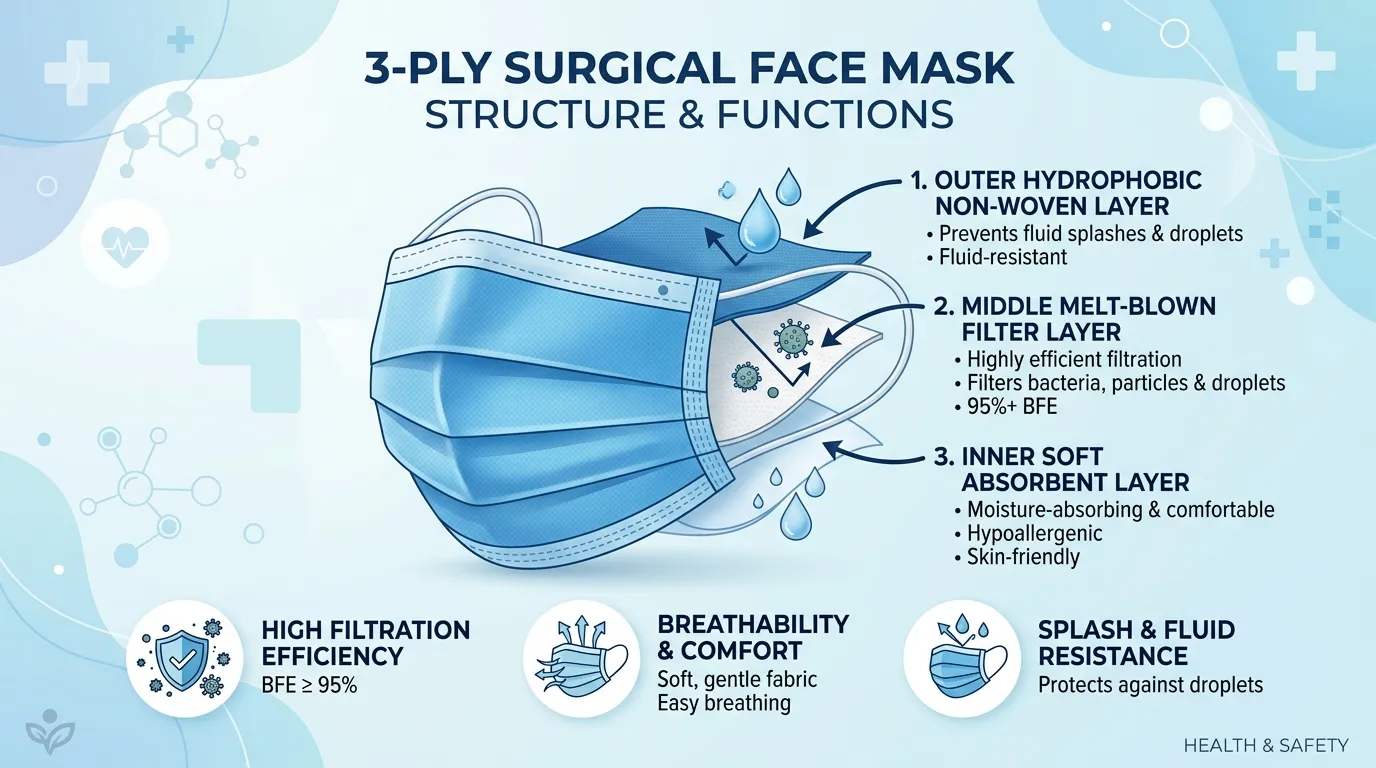
3 Ply Surgical Face Masks provide reliable protection against bacteria, fluids, and airborne particles through a three-layer non-woven design. Widely used in healthcare and everyday settings, these disposable masks offer an effective balance of filtration, comfort, and breathability. Choosing certified 3 Ply Surgical Face Masks that meet EN14683 or ASTM standards helps ensure safety, compliance, and dependable performance.
3 ply surgical face masks are disposable, single-use masks made from three layers of non-woven material. They protect against fluid, bacteria, and airborne particles in medical and everyday settings. Compliance standards like EN14683 and ASTM Level 1 help determine which mask is appropriate for a given environment.
Walk into any hospital, clinic, or pharmacy, and you’ll find them stacked by the box: 3 ply surgical face masks. They’re one of the most widely used forms of personal protective equipment (PPE) in the world—and for good reason. Lightweight, affordable, and effective when used correctly, these masks have become a staple in healthcare settings and daily life alike.
But not all surgical masks are created equal. The materials, construction, filtration ratings, and compliance standards vary more than most people realize. Choosing the wrong mask for the wrong environment can leave wearers with a false sense of protection. Choosing the right one, however, can meaningfully reduce the spread of infection, protect clinical staff, and meet strict regulatory requirements.
This guide covers everything you need to know about 3 ply surgical face masks—from how they’re constructed and what standards they must meet, to how to choose the right mask for your specific needs. Whether you’re sourcing hospital-grade masks for a medical facility or simply looking for a reliable single-use option for everyday use, this guide has you covered.
What Are 3 Ply Surgical Face Masks?
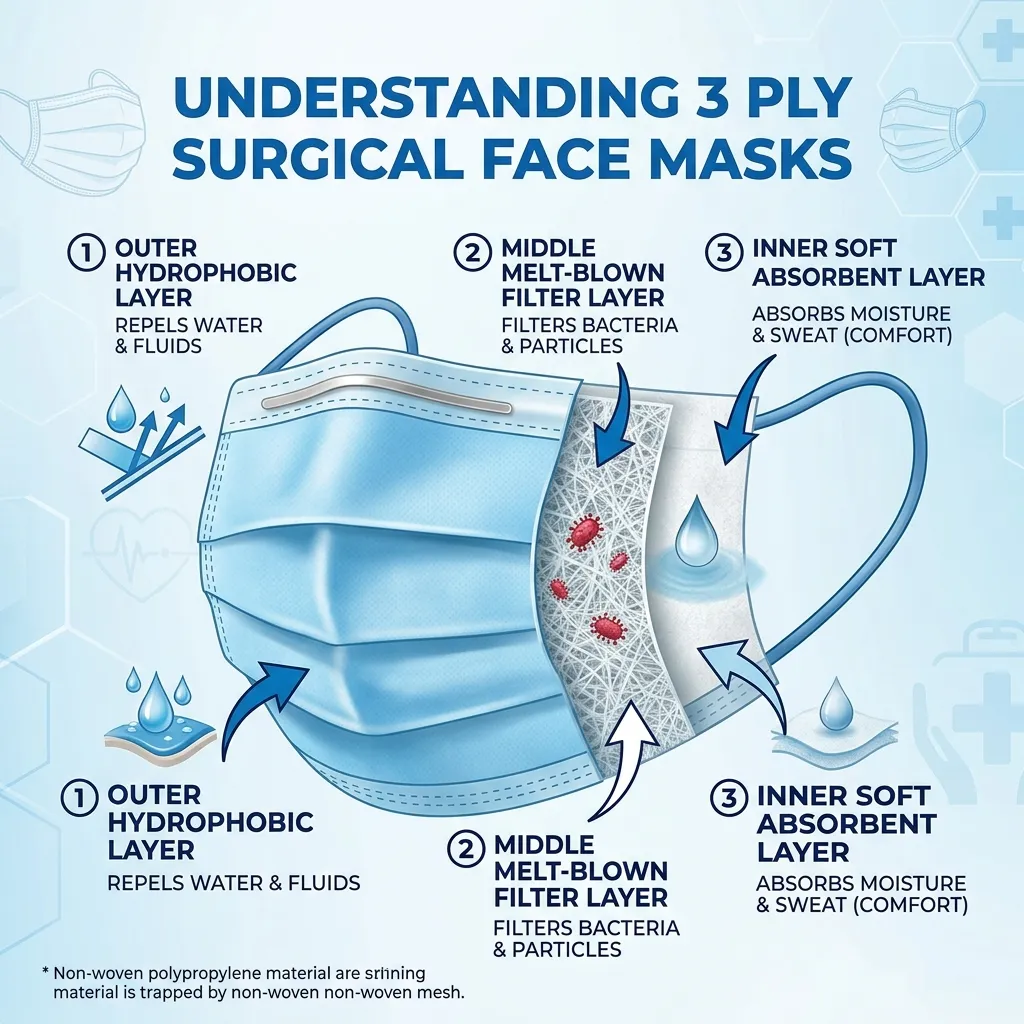
A 3 ply surgical face mask is a disposable, single-use mask constructed from three distinct layers of non-woven fabric, each serving a specific protective function. Together, these layers form a barrier against bacteria, fluids, and particulates—making them a trusted choice in medical, clinical, and public health contexts.
The term “3 ply” refers directly to the three-layer design:
- Outer layer: Typically a spunbond polypropylene layer that repels fluid and provides structural integrity.
- Middle layer: A melt-blown polypropylene filter layer—the most critical component—responsible for filtering out fine particles and microorganisms.
- Inner layer: A soft, skin-friendly spunbond layer designed for comfort against the face.
This three-layer architecture is what separates a proper 3 ply surgical mask from cheaper, single-layer alternatives. The melt-blown middle layer, in particular, is what makes these masks effective as a filtration barrier.
How Are 3 Ply Surgical Masks Made?
What materials are used in non-woven surgical masks?
Non-woven surgical masks are made from polypropylene fibers that are bonded together through heat or chemical processes—not woven like traditional fabric. This manufacturing method creates a material that is both lightweight and highly effective at trapping particles.
The melt-blown polypropylene used in the middle filtration layer is produced by extruding molten plastic through tiny nozzles at high velocity, creating ultra-fine fibers with exceptional filtration properties. This process is central to a mask’s ability to filter bacteria and fine particles efficiently.
Non-woven materials are also resistant to moisture absorption, which helps maintain structural integrity and filtration performance even in high-humidity environments—an important quality for masks worn during medical procedures.
Why is the three-layer design better than single or double-layer masks?
Single or double-layer masks lack the dedicated filtration layer that makes 3 ply masks effective in medical settings. A single-layer cloth mask, for instance, may block large droplets but offers minimal protection against smaller airborne particles. The three-layer design, by contrast, creates a system where each layer performs a distinct role—fluid resistance on the outside, particle filtration in the middle, and comfort on the inside.
Medical 3 Ply Face Masks: Who Uses Them and Why?
Medical 3 ply face masks are primarily used by healthcare professionals—doctors, nurses, dentists, and surgical staff—who require reliable protection during patient care. They’re also widely used in clinical laboratories, pharmacies, aged care facilities, and anywhere infection control is a priority.
Beyond the healthcare sector, 3 ply surgical masks are used by:
- General public: For respiratory protection during outbreaks or in crowded public spaces.
- Food industry workers: To prevent contamination during food preparation and handling.
- Manufacturing and industrial settings: Where dust and particulate exposure is a concern.
- Schools and childcare facilities: As a hygiene precaution during cold and flu season.
The broad applicability of 3 ply surgical masks makes them one of the most versatile single-use PPE options available.
Fluid-Resistant Surgical Masks: Why Splash Protection Matters
One of the most important—and often overlooked—features of a hospital-grade surgical mask is its fluid resistance. Medical procedures frequently involve exposure to blood, saliva, and other bodily fluids. A fluid-resistant surgical mask provides a barrier that prevents liquid from penetrating through to the wearer’s nose and mouth.
Fluid resistance is measured by a mask’s splash resistance level, typically tested using a synthetic blood penetration test. Higher-rated masks withstand greater pressure from fluid spray, which is critical in surgical environments where high-velocity splatter can occur.
This is why hospital-grade surgical masks are specifically engineered to meet fluid resistance thresholds—and why using a non-medical mask in a clinical setting poses real risks.
Breathable 3 Ply Face Masks: Balancing Protection and Comfort
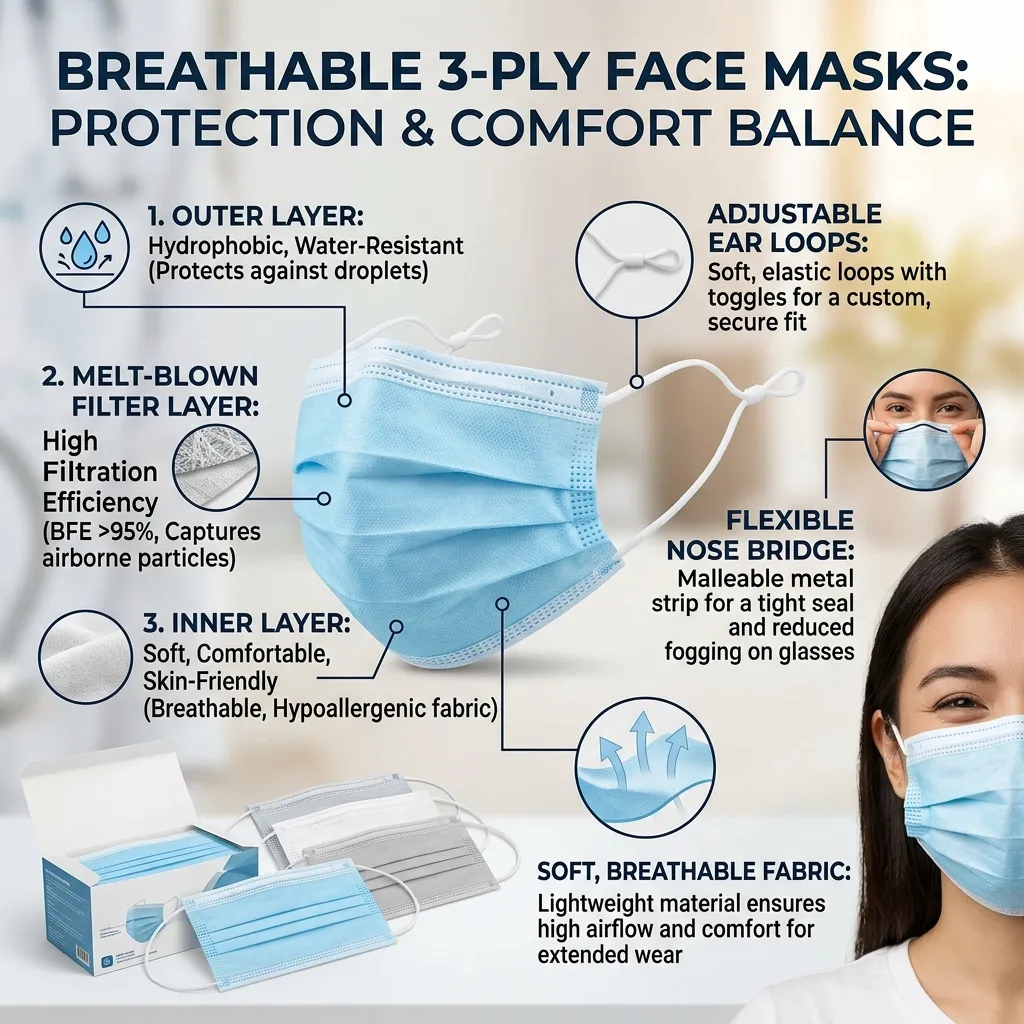
A common concern about surgical masks—especially in long-wear scenarios—is breathability. Fortunately, well-manufactured breathable 3 ply face masks achieve an effective balance between filtration performance and airflow resistance.
Breathability in a surgical mask is measured by differential pressure, or the resistance to airflow across the mask. A lower differential pressure means easier breathing, which is particularly important for healthcare workers who wear masks for extended shifts.
High-quality breathable 3 ply face masks use advanced melt-blown technology that maintains filtration efficiency without significantly restricting airflow. When sourcing masks for healthcare environments, look for products that report differential pressure values—this data is often included in compliance documentation.
Understanding Compliance Standards for Surgical Masks
What does EN14683 compliant mean for surgical masks?
EN14683 is the European standard for surgical face masks. It specifies requirements for construction, design, and performance—including bacterial filtration efficiency (BFE), differential pressure (breathability), splash resistance, and microbial cleanliness.
There are two primary types under EN14683:
- Type I: Minimum BFE of 95%. Recommended for the general public and non-surgical use.
- Type II: Minimum BFE of 98%. Recommended for use by healthcare professionals.
- Type IIR: Minimum BFE of 98%, with added fluid resistance. Required for surgical environments.
EN14683 compliant surgical masks must pass all relevant tests before they can be marketed as medical devices in Europe. When sourcing masks for clinical or hospital use in Europe, always verify the EN14683 type classification.
What is an ASTM Level 1 surgical mask, and when should you use one?
ASTM International (formerly the American Society for Testing and Materials) has established a three-tier classification system for surgical masks used in the United States:
- ASTM Level 1: Low barrier protection. Suitable for general patient care, dental procedures, and non-aerosol-generating environments. Requires a BFE of ≥95% and moderate fluid resistance.
- ASTM Level 2: Moderate barrier protection. Suitable for procedures with low-to-moderate aerosol, spray, or fluid exposure.
- ASTM Level 3: Maximum barrier protection. Required for procedures with high aerosol, spray, and fluid exposure.
ASTM Level 1 surgical masks are the most widely used category and are appropriate for most outpatient and general clinical settings. They offer reliable bacterial filtration and basic fluid resistance without the added layers required for high-exposure surgical environments.
Choose ASTM Level 1 if: Your environment involves low fluid exposure and standard patient interaction. Choose ASTM Level 3 if: Procedures generate significant aerosol or involve high fluid exposure.
Single-Use Surgical Masks: Proper Use and Disposal
Disposable 3 ply surgical masks are designed for single-use only—and this matters more than many people realize. Reusing a single-use surgical mask compromises its structural integrity, reduces filtration efficiency, and increases the risk of cross-contamination.
Best practices for using and disposing of single-use surgical masks include:
- Inspect before use: Check for tears, moisture, or visible damage before putting on the mask.
- Fit the mask correctly: The colored side faces outward; the metal nose wire should be molded to the bridge of the nose to minimize gaps.
- Avoid touching the front: The outer layer may carry contaminants—handle masks by the ear loops.
- Replace when wet or soiled: A wet or damaged mask is no longer effective and should be replaced immediately.
- Dispose of safely: Place used masks in a closed waste bin. In clinical settings, follow local infection control protocols for PPE disposal.
How to Source Hospital-Grade Surgical Masks
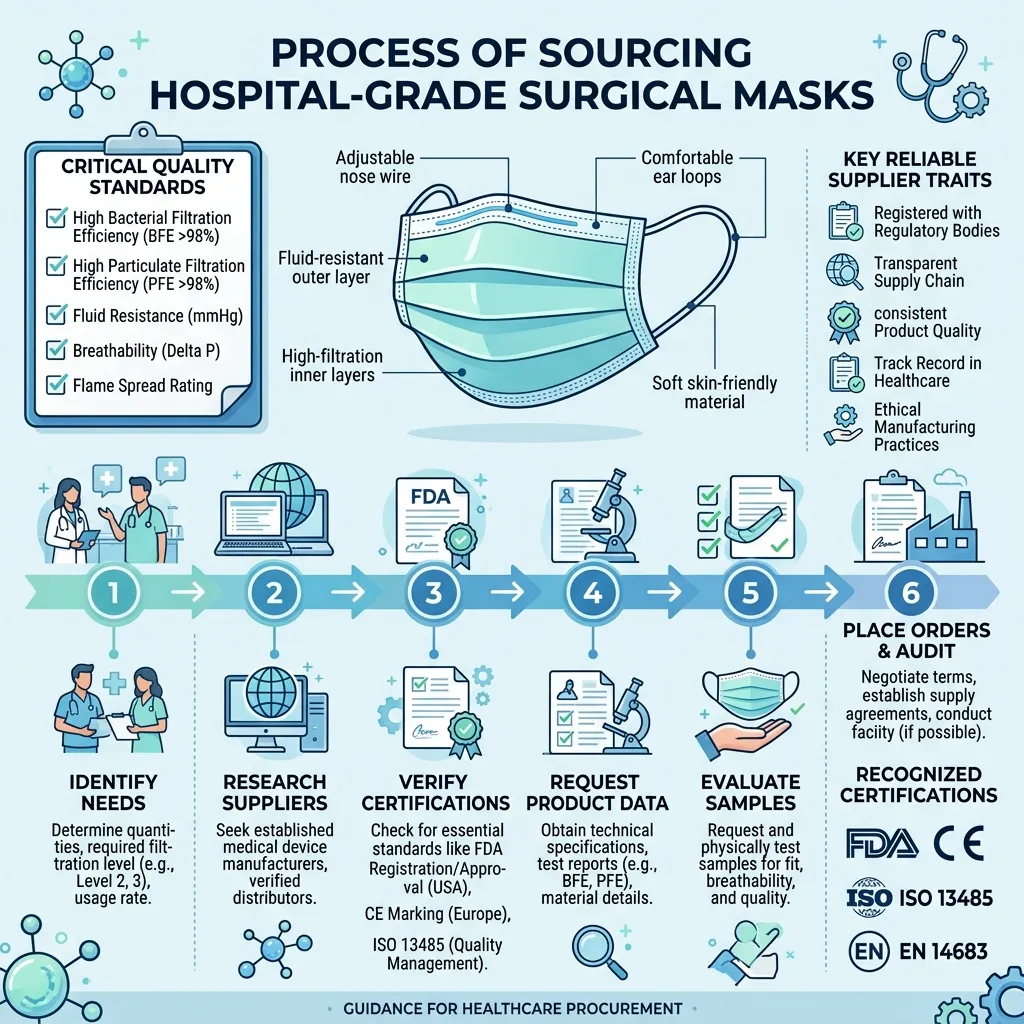
When sourcing hospital-grade surgical masks for a medical facility, prioritize the following:
- Verified compliance documentation: Request EN14683 or ASTM test certificates from the manufacturer or distributor.
- Bacterial Filtration Efficiency (BFE) data: Hospital-grade masks should achieve a BFE of ≥98%.
- Fluid resistance rating: Confirm that masks meet the minimum splash resistance requirement for your specific use case.
- Traceability: Reputable suppliers should be able to provide batch numbers, manufacturing dates, and country of origin.
- Packaging integrity: Masks should be individually packed or stored in sealed boxes to prevent contamination before use.
Avoid sourcing from unverified suppliers, particularly when compliance documentation cannot be produced on request.
The Right Mask Makes a Real Difference
3 ply surgical face masks are a frontline tool in infection control—but their effectiveness depends on choosing the right product for the right setting. A Type IIR EN14683 mask in a surgical environment and an ASTM Level 1 mask in a general practice clinic are both appropriate choices—but only because they’ve been matched to their context.
Understanding the construction, compliance standards, and performance characteristics of 3 ply surgical masks empowers healthcare administrators, procurement teams, and everyday users to make decisions that actually protect people. The details matter: BFE ratings, fluid resistance levels, breathability scores, and compliance certifications aren’t just numbers on a spec sheet—they’re the difference between a mask that works and one that merely looks like it does.
Frequently Asked Questions
What is a 3 ply surgical face mask made of?
A 3 ply surgical mask is made from three layers of non-woven polypropylene. The outer layer repels fluids, the middle melt-blown layer filters particles and bacteria, and the inner layer provides soft, comfortable contact against the skin.
How effective are 3 ply surgical masks at filtering bacteria?
High-quality 3 ply surgical masks achieve a Bacterial Filtration Efficiency (BFE) of 98% or higher when compliant with EN14683 Type II/IIR or ASTM Level 2/3 standards. ASTM Level 1 and EN14683 Type I masks achieve a minimum BFE of 95%.
What is the difference between EN14683 and ASTM surgical mask standards?
EN14683 is the European standard for surgical masks, classifying masks as Type I, II, or IIR based on BFE and fluid resistance. ASTM is the American standard, with three levels (1, 2, 3) based on similar performance criteria. Both systems assess BFE, breathability, and fluid resistance, but use different test methodologies and threshold values.
Can you reuse a disposable 3 ply surgical mask?
No. Disposable 3 ply surgical masks are single-use only. Reusing them reduces filtration effectiveness, risks cross-contamination, and compromises the structural integrity of the mask. Always replace a mask when it becomes wet, soiled, or damaged.
What does fluid-resistant mean for a surgical mask?
Fluid resistance refers to a mask’s ability to repel liquid splatter—such as blood or saliva—under pressure. It is measured using a synthetic blood penetration test. EN14683 Type IIR masks and ASTM Level 2/3 masks meet specific fluid resistance thresholds, making them suitable for surgical and high-exposure environments.
What is the best 3 ply surgical mask for hospital use?
For hospital and surgical environments, look for masks rated EN14683 Type IIR or ASTM Level 3. These offer maximum bacterial filtration efficiency (≥98%) and high fluid resistance, making them appropriate for procedures with significant aerosol or fluid exposure.
What are 3 Ply Surgical Face Masks?
3 Ply Surgical Face Masks are disposable masks made with three non-woven layers that help protect against bacteria, fluids, and respiratory droplets.
What are the three layers of a 3 ply surgical mask?
The mask consists of an outer fluid-resistant layer, a middle melt-blown filtration layer, and a soft inner layer for comfort.
Are 3 Ply Surgical Face Masks reusable?
No. 3 Ply Surgical Face Masks are designed for single use and should be discarded after use or when they become wet or damaged.
Who should use 3 Ply Surgical Face Masks?
They are commonly used by healthcare professionals, patients, food industry workers, caregivers, and the general public for infection control.
What is the difference between a surgical mask and a cloth mask?
A surgical mask offers higher filtration efficiency and fluid resistance, while cloth masks mainly provide basic source control and vary in effectiveness.
What do EN14683 and ASTM standards mean?
These are international standards that evaluate surgical masks for bacterial filtration, breathability, and fluid resistance to ensure quality and safety.
Are 3 Ply Surgical Face Masks effective against bacteria?
Yes. Certified 3 Ply Surgical Face Masks can achieve bacterial filtration efficiency (BFE) of 95% to 98% or higher, depending on the certification level.
How often should I replace a 3 ply surgical mask?
Replace the mask after each use or immediately if it becomes wet, dirty, or damaged.
How do I choose high-quality 3 Ply Surgical Face Masks?
Look for masks with EN14683 or ASTM certification, high BFE ratings, fluid resistance, breathable materials, and reliable manufacturer documentation.
Where are 3 Ply Surgical Face Masks commonly used?
They are widely used in hospitals, clinics, laboratories, dental offices, pharmacies, schools, public spaces, and workplaces where hygiene and infection control are important.
