
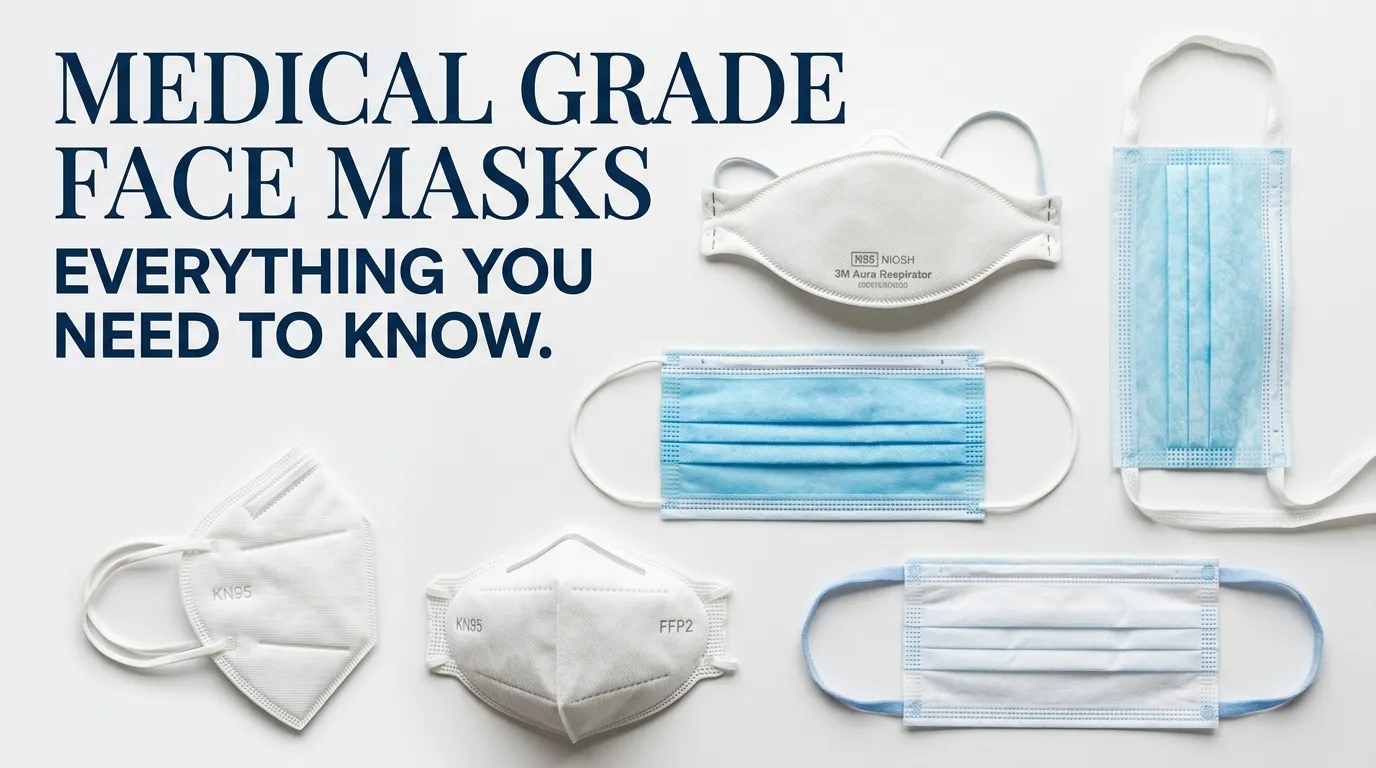
Medical Grade Face Masks—including surgical masks, N95 respirators, and KN95 masks—are certified protective devices designed to filter airborne particles, bacteria, and viruses. They are regulated by standards such as ASTM and NIOSH, which define their safety and filtration levels. Choosing the right mask depends on exposure risk, with higher-rated options like ASTM Level 3 and N95 offering stronger protection for healthcare and high-risk environments.
Choosing the wrong face mask isn’t just inconvenient—it can leave you dangerously underprotected. With dozens of mask types on the market, each carrying different certifications, filtration ratings, and intended uses, the difference between a surgical face mask and a high-filtration respirator matters enormously, especially in clinical and high-risk settings.
This guide breaks down every major category of medical grade face mask, from disposable surgical options to ASTM Level 3 and N95 respirators. Whether you’re sourcing masks for a hospital, a clinic, or personal health protection, understanding what each certification actually means will help you make a confident, informed decision.
By the end of this post, you’ll know exactly which mask type suits your needs, what standards to look for, and why certified protection is non-negotiable.
What Makes a Face Mask “Medical Grade”?
Not all face masks are created equal. A basic cloth mask and a certified medical grade face mask may look similar, but their performance differs dramatically under controlled testing conditions.
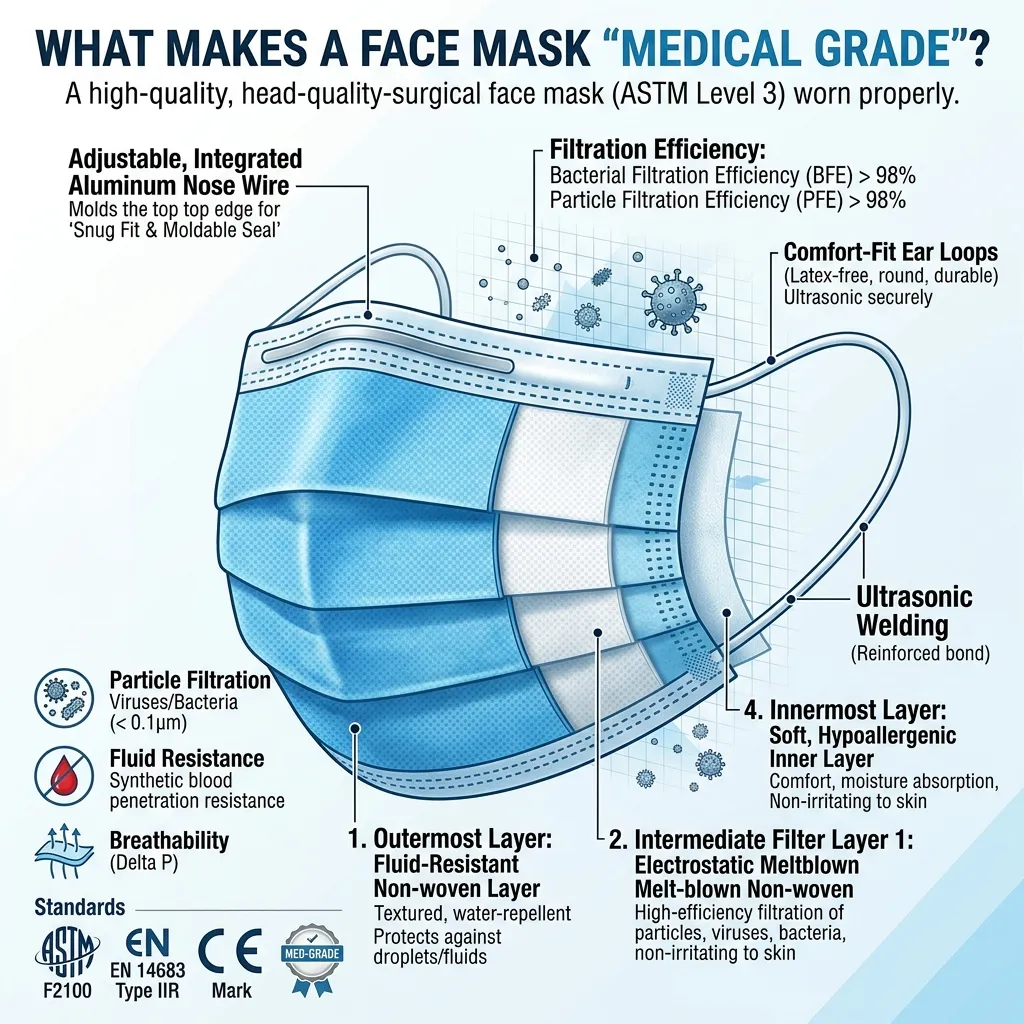
A medical grade face mask must meet strict regulatory standards for filtration efficiency, fluid resistance, breathability, and flammability. In the United States, the American Society for Testing and Materials (ASTM) sets the benchmark for surgical and procedural masks, while the National Institute for Occupational Safety and Health (NIOSH) certifies respirators like the N95.
These standards exist to protect both patients and healthcare workers from airborne pathogens, bodily fluids, and particulate matter. A mask without certification offers no guaranteed level of protection.
Surgical Face Masks: Medical Grade Protection in a Familiar Form
The surgical face mask is the most recognizable medical grade mask in healthcare settings. Worn by surgeons, nurses, and clinical staff, these masks are designed to protect the wearer from splashes and large-particle droplets while also reducing the spread of respiratory secretions.
Surgical masks must meet ASTM standards for:
- Bacterial Filtration Efficiency (BFE): The percentage of bacteria filtered at a specific particle size
- Particle Filtration Efficiency (PFE): Protection against sub-micron particles
- Fluid Resistance: The mask’s ability to resist penetration by blood and body fluids
- Breathability (Differential Pressure): How easily air flows through the mask
A protective surgical mask for healthcare use typically falls into one of three ASTM performance levels, which we’ll explore in detail below.
What Are the ASTM Levels for Disposable Medical Face Masks?
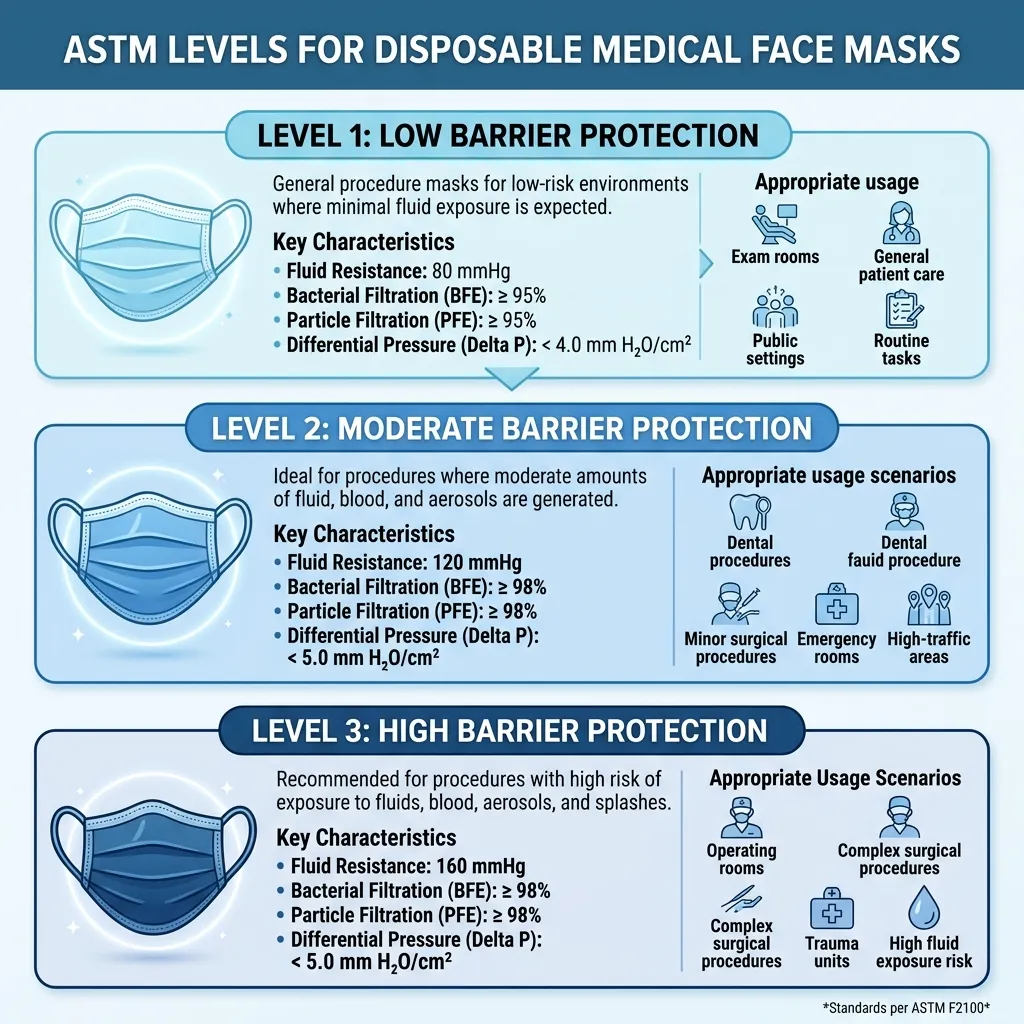
ASTM International classifies disposable medical face masks into three performance levels based on their protective capacity:
ASTM Level 1 — Low Barrier Protection
Level 1 masks offer basic filtration and are suitable for low-risk procedures with minimal aerosol, spray, or fluid exposure. They’re commonly used in general exam rooms and non-surgical clinical environments.
- BFE: ≥95%
- PFE: ≥95%
- Fluid Resistance: 80 mmHg
ASTM Level 2 — Moderate Barrier Protection
Level 2 masks offer a step up in fluid resistance and filtration, suitable for moderate-risk procedures where low-to-moderate amounts of aerosol or fluid are anticipated.
- BFE: ≥98%
- PFE: ≥98%
- Fluid Resistance: 120 mmHg
ASTM Level 3 Face Mask — Maximum Barrier Protection
The ASTM Level 3 face mask represents the highest performance tier for surgical masks. These are the go-to choice for procedures involving significant aerosol generation, blood splatter, or fluid exposure—such as oral surgeries, emergency procedures, and high-risk clinical environments.
- BFE: ≥98%
- PFE: ≥98%
- Fluid Resistance: 160 mmHg
For any clinical environment involving elevated exposure risk, an ASTM Level 3 certified mask is the minimum recommended standard.
N95 Respirator Mask Protection: How It Works and When You Need It
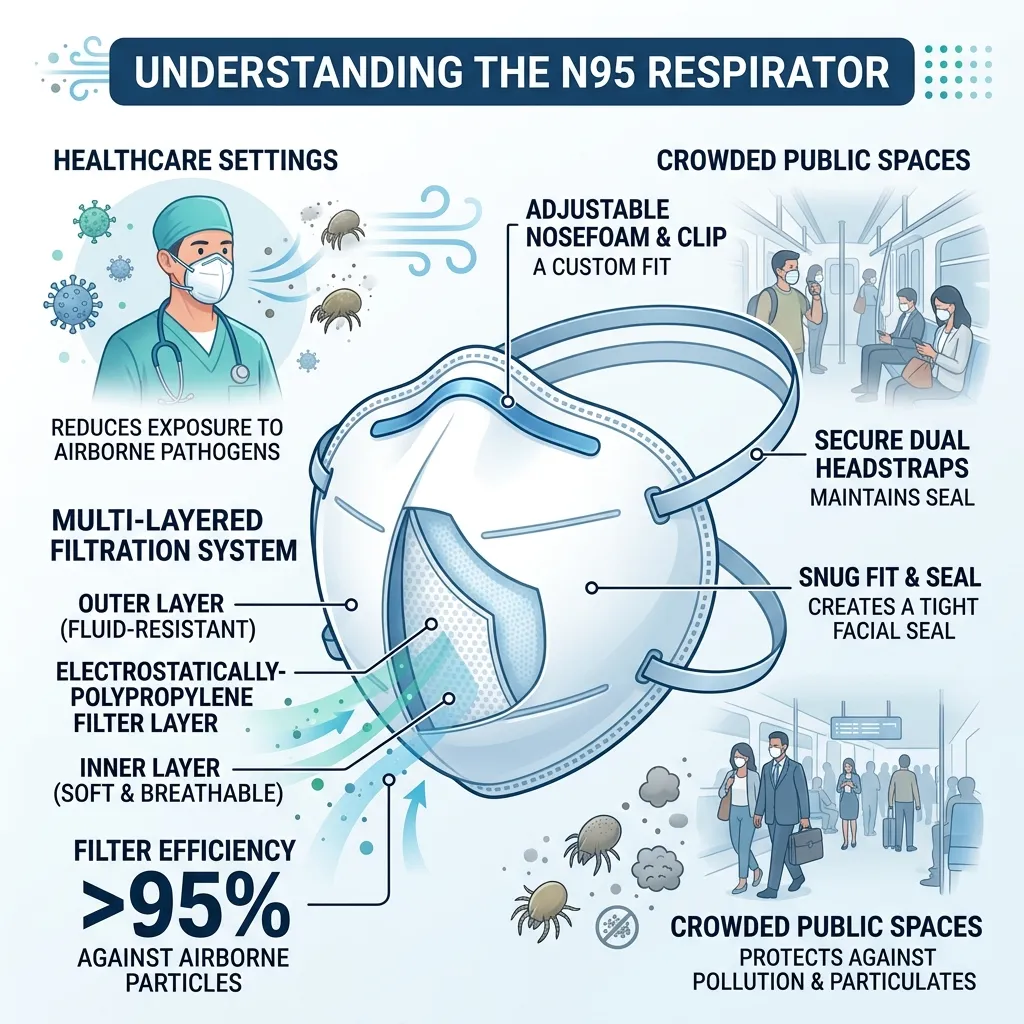
The N95 respirator is the gold standard for airborne particle protection in the United States. Certified by NIOSH under 42 CFR Part 84, N95 respirators filter at least 95% of airborne particles, including those as small as 0.3 microns—the hardest size to capture.
Unlike surgical masks, N95 respirators form a tight seal around the face, preventing unfiltered air from leaking around the edges. This fit-dependent protection makes N95 masks significantly more effective than standard surgical masks for airborne disease transmission.
Key features of N95 respirator mask protection include:
- ≥95% filtration of non-oil-based particles
- NIOSH certification printed directly on the mask
- Tight facial seal requiring fit testing for occupational use
- Recommended for high-risk settings: emergency departments, COVID-19 wards, and airborne infection isolation rooms
The CDC recommends N95 respirators for healthcare workers performing aerosol-generating procedures or treating patients with confirmed airborne infections. For verified N95 masks, always check the NIOSH Certified Equipment List (CEL) before purchasing.
KN95 Medical Grade Mask: What’s the Difference from N95?
The KN95 medical grade mask is China’s equivalent to the U.S. N95 standard, regulated under China’s GB2626-2019 standard. Like the N95, KN95 masks filter at least 95% of non-oil-based particulate matter.
However, there are meaningful differences:
|
Feature |
N95 |
KN95 |
|---|---|---|
|
Certifying body |
NIOSH (USA) |
CNCA (China) |
|
Filtration efficiency |
≥95% |
≥95% |
|
Fit test required |
Yes (occupational) |
No |
|
Exhalation valve |
Optional |
Optional |
|
Recognition in US healthcare |
Widely accepted |
EUA-dependent |
During the COVID-19 pandemic, the FDA issued Emergency Use Authorizations (EUAs) for certain KN95 masks to address N95 shortages. However, KN95 masks are not NIOSH-certified, meaning their performance varies by manufacturer. Always source KN95 masks from verified suppliers and check for valid third-party testing documentation.
For most non-healthcare uses—commuting, indoor crowded spaces, or general virus protection—a certified KN95 medical grade mask offers excellent protection.
Hospital Grade Face Masks: What Healthcare Facilities Actually Require
The term “hospital grade face mask” refers broadly to masks that meet the regulatory and performance thresholds required for use in clinical environments. In practice, this means:
- For non-surgical staff and patient interaction: ASTM Level 1 or Level 2 surgical masks
- For operating theaters and high-risk procedures: ASTM Level 3 surgical masks
- For aerosol-generating procedures and airborne isolation: N95 respirators or higher
Hospitals typically maintain tiered mask protocols based on department risk levels. ICU wards, isolation rooms, and surgical suites demand higher-rated masks, while administrative areas may only require Level 1 compliance.
When sourcing hospital grade face masks, procurement teams should verify FDA 510(k) clearance, confirm ASTM performance level labeling, and request certificates of conformance from suppliers.
High Filtration Face Masks for Medical Use: Beyond the Standard Options
For specialized medical applications, high filtration face masks go beyond standard ASTM and N95 thresholds. Options in this category include:
- N99 and N100 respirators: Filtering 99% and 99.97% of airborne particles respectively, these are used in extreme-risk environments such as TB wards and biocontainment units.
- Powered Air-Purifying Respirators (PAPRs): For workers who cannot achieve an adequate seal with a standard respirator due to facial hair or anatomy, PAPRs provide motorized filtered airflow via a hood or helmet.
- Elastomeric half-mask respirators: Reusable respirators with replaceable filters, offering N95-equivalent or higher protection with a more durable fit.
For most healthcare settings, N95 respirators provide sufficient protection. High filtration masks beyond N95 are warranted in situations involving confirmed highly infectious airborne pathogens.
Antiviral Medical Face Masks: Do They Offer Extra Protection?
The antiviral medical face mask market has grown significantly since the COVID-19 pandemic. These masks incorporate antiviral coatings—typically using copper ions, silver nanoparticles, or other antimicrobial agents—designed to inactivate viruses that land on the mask surface.
It’s important to understand what antiviral treatments do and don’t do:
- They may reduce surface viral load on the mask material itself
- They do not replace filtration efficiency—the core metric for stopping inhaled particles
- They are not substitutes for ASTM or NIOSH-certified masks in clinical settings
An antiviral medical face mask with verified ASTM certification offers the best of both worlds: mechanical filtration plus antimicrobial surface treatment. Without underlying certification, the antiviral label alone provides no guaranteed clinical protection.
Certified Medical Face Mask Standards: What to Look for Before You Buy
Purchasing certified medical face masks requires attention to specific labeling and documentation. Here’s what to verify:
- ASTM Level designation (for surgical and procedural masks)
- NIOSH approval number (for N95 respirators; verify on the NIOSH CEL)
- FDA 510(k) clearance number (for surgical masks sold in the US)
- CE marking (for masks sold in the European Union under EN 14683 or EN 149)
- Third-party test reports from accredited laboratories (ISO/IEC 17025 accredited)
- Lot numbers and manufacturer traceability
Counterfeit masks remain a significant problem. The FDA maintains a database of fraudulent COVID-19 products, and NIOSH provides a list of counterfeit N95 masks on its website. Purchasing directly from authorized distributors or verified manufacturers significantly reduces the risk of receiving non-compliant products.
The Right Mask for the Right Setting: A Practical Summary
|
Setting |
Recommended Mask |
|---|---|
|
General medical office |
ASTM Level 1 surgical mask |
|
Clinical procedures, moderate risk |
ASTM Level 2 surgical mask |
|
Surgery, high-fluid-exposure procedures |
ASTM Level 3 surgical mask |
|
COVID-19 patient care, airborne isolation |
N95 respirator (NIOSH-certified) |
|
High-risk airborne pathogens |
N99/N100 or PAPR |
|
General public, high-density spaces |
KN95 from verified supplier |
Make the Right Call on Medical Grade Face Mask Protection
Medical grade face mask selection is not a one-size-fits-all decision. The difference between an ASTM Level 1 and a Level 3 mask, or between a surgical mask and an N95 respirator, can directly impact patient outcomes and caregiver safety.
Prioritize certification above all else. Look for ASTM performance levels, NIOSH approval numbers, and FDA clearance documentation before committing to any mask for clinical or high-risk use. When purchasing for institutional use, establish supplier relationships that include full traceability and conformance documentation.
For individual protection, a certified KN95 or N95 respirator from a verified manufacturer offers reliable defense against airborne particles and viral exposure. When in doubt, choose higher filtration—the cost difference between mask levels is negligible compared to the protection they provide.
Frequently Asked Questions
What is the difference between a surgical mask and an N95 respirator?
A surgical mask filters large droplets and provides fluid resistance but does not seal tightly to the face. An N95 respirator forms a tight facial seal and filters at least 95% of airborne particles, including sub-micron particles. N95 respirators offer significantly higher protection against airborne transmission.
What does ASTM Level 3 mean on a face mask?
ASTM Level 3 is the highest performance tier for surgical masks under ASTM F2100 standards. Level 3 masks meet the most stringent requirements for bacterial filtration (≥98%), particle filtration (≥98%), and fluid resistance (160 mmHg), making them suitable for high-risk surgical and clinical procedures.
Are KN95 masks considered medical grade?
KN95 masks meet China’s GB2626-2019 standard for particulate filtering respirators and filter at least 95% of airborne particles. They are not NIOSH-certified and are not classified as medical grade under US FDA regulations. However, from verified manufacturers with third-party testing documentation, KN95 masks offer strong protection for non-clinical and general-public use.
How do I know if an N95 mask is genuine?
Check the NIOSH Certified Equipment List (CEL) at cdc.gov/niosh. Genuine N95 masks display the NIOSH approval number, manufacturer name, and model number directly on the mask. NIOSH also maintains a list of counterfeit N95 masks for reference.
What is the best face mask for antiviral protection in a hospital setting?
For hospital use involving aerosol-generating procedures or airborne infection risk, a NIOSH-certified N95 respirator is the recommended minimum standard. For maximum protection in extreme-risk environments, N99/N100 respirators or powered air-purifying respirators (PAPRs) are appropriate alternatives.
Can disposable medical face masks be reused?
Disposable medical face masks are designed for single use. Reuse risks structural degradation, reduced filtration efficiency, and contamination transfer. N95 respirators may be rotated over multiple shifts under specific extended use protocols—as defined by NIOSH and the CDC—but should never be shared between users.
