


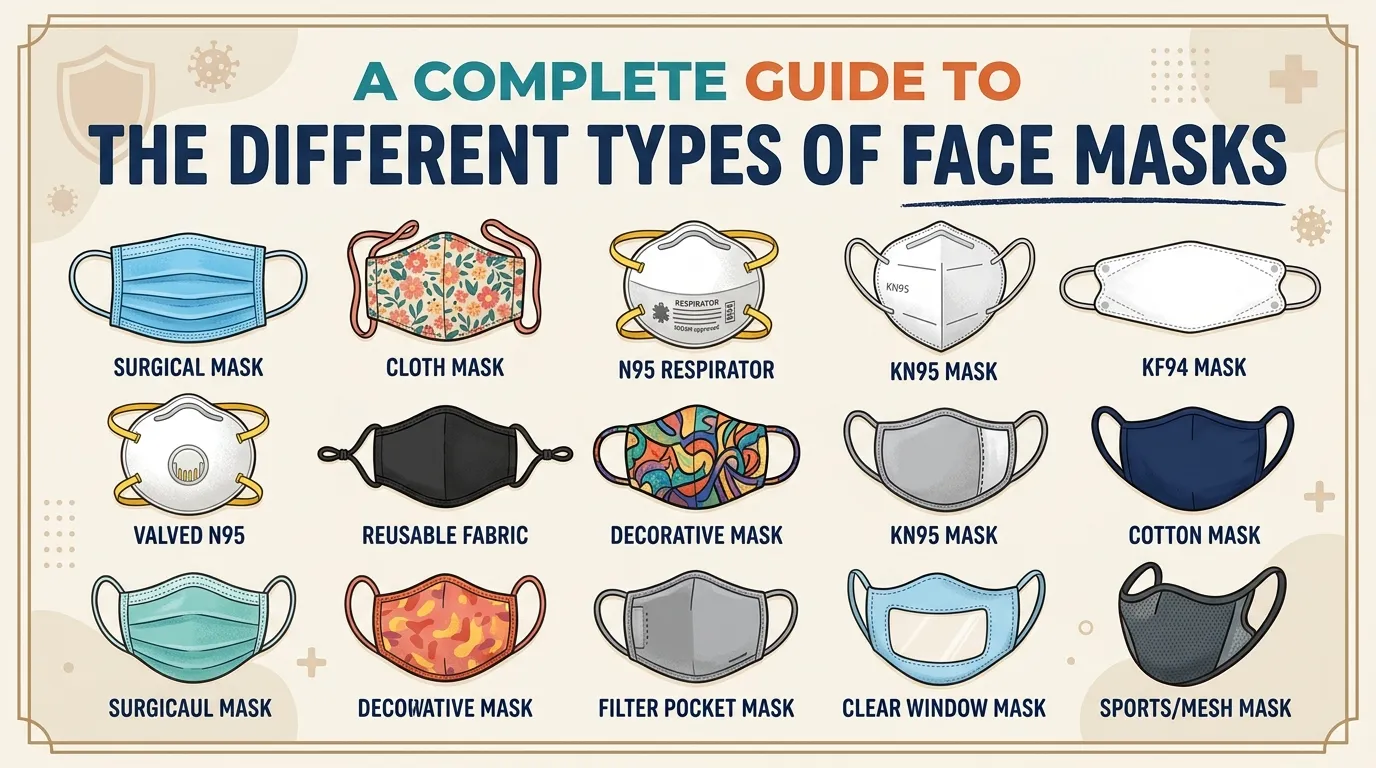
Different types of face masks offer varying levels of protection based on their design, filtration efficiency, and intended use. From surgical masks and N95 respirators to KN95, disposable, and reusable cloth masks, choosing the right option depends on your environment, exposure risk, and comfort. Understanding each mask type helps ensure better protection in both healthcare and everyday settings.
Face masks fall into two broad categories—medical and non-medical. Medical types include surgical masks and N95 respirators, while non-medical options range from cloth masks to reusable fabric designs. The right mask depends on your exposure risk, intended use, and whether you need certified protection or everyday coverage.
Face masks have become a fixture in healthcare settings, workplaces, and everyday life. But walk into any pharmacy or browse online, and you’ll quickly discover that not all masks are created equal. Some block fine airborne particles. Others filter bacteria. Some are designed for a single use, while others can be washed and worn for months.
Choosing the wrong type doesn’t just mean mild inconvenience—it can mean inadequate protection when it matters most. This guide breaks down every major type of face mask, explains how each one works, and helps you figure out which option is right for your situation.
What Are the Main Types of Face Masks?
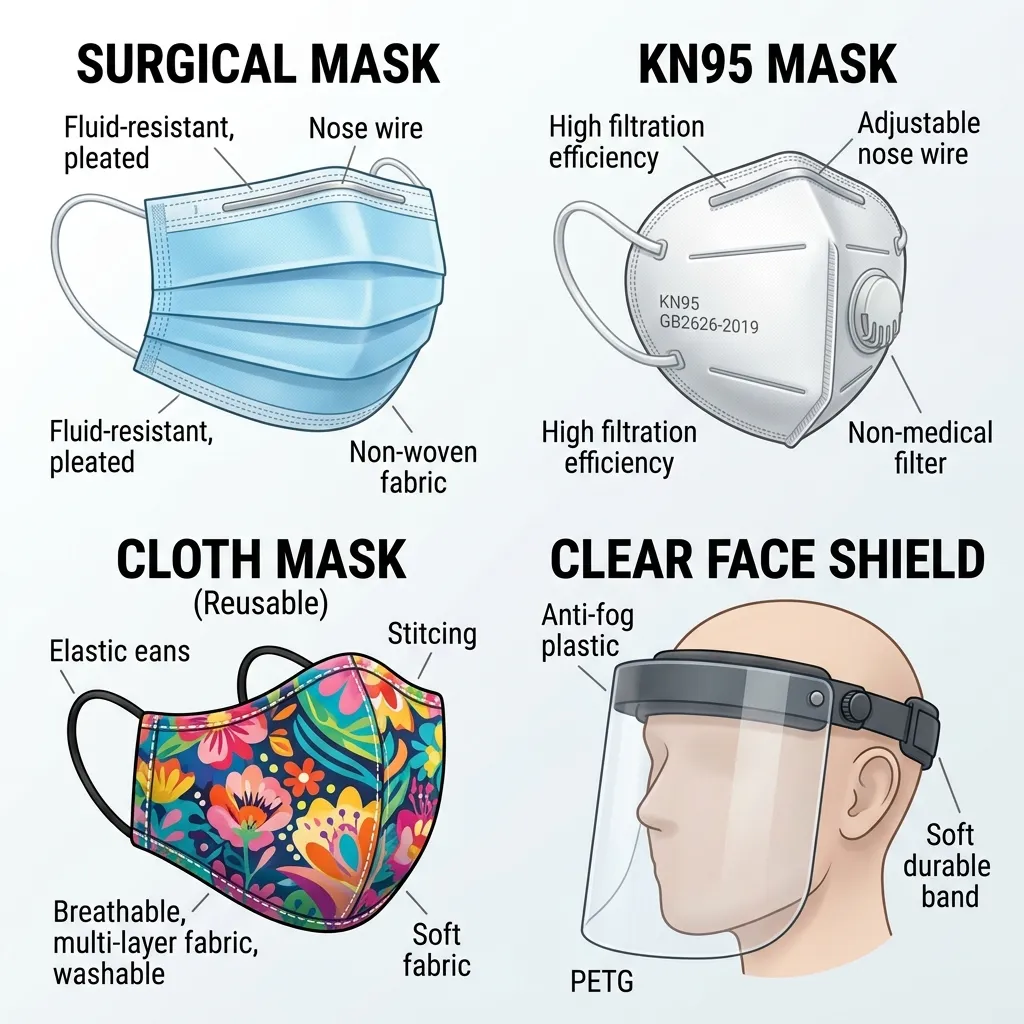
Face masks are broadly split into two categories: medical-grade and non-medical. Within those categories, masks vary significantly by material, filtration efficiency, fit, and intended use.
Here’s a quick overview:
- Surgical masks – Loose-fitting, disposable, designed to protect others from the wearer
- N95 respirators – Tight-fitting, high-filtration masks that protect both the wearer and others
- KN95 masks – The Chinese equivalent of N95s, widely available for general use
- Cloth/reusable masks – Fabric masks designed for everyday non-medical use
- Disposable face masks – Single-use masks typically made from non-woven polypropylene
- Specialty masks – Masks designed for specific industries, such as construction or healthcare
Understanding where each type fits helps you match the mask to the moment.
Face Mask Types and Their Uses
The purpose of a face mask determines its design. Some are built to protect the wearer from inhaling hazardous particles. Others exist primarily to prevent the wearer from spreading droplets. And some do both, to varying degrees.
A cloth mask worn during a grocery run serves a completely different function than an N95 worn by a nurse in an ICU. Here’s how the major types stack up across different scenarios.
Medical Face Mask Types: Surgical vs. N95
What Is a Surgical Mask, and When Should You Use One?
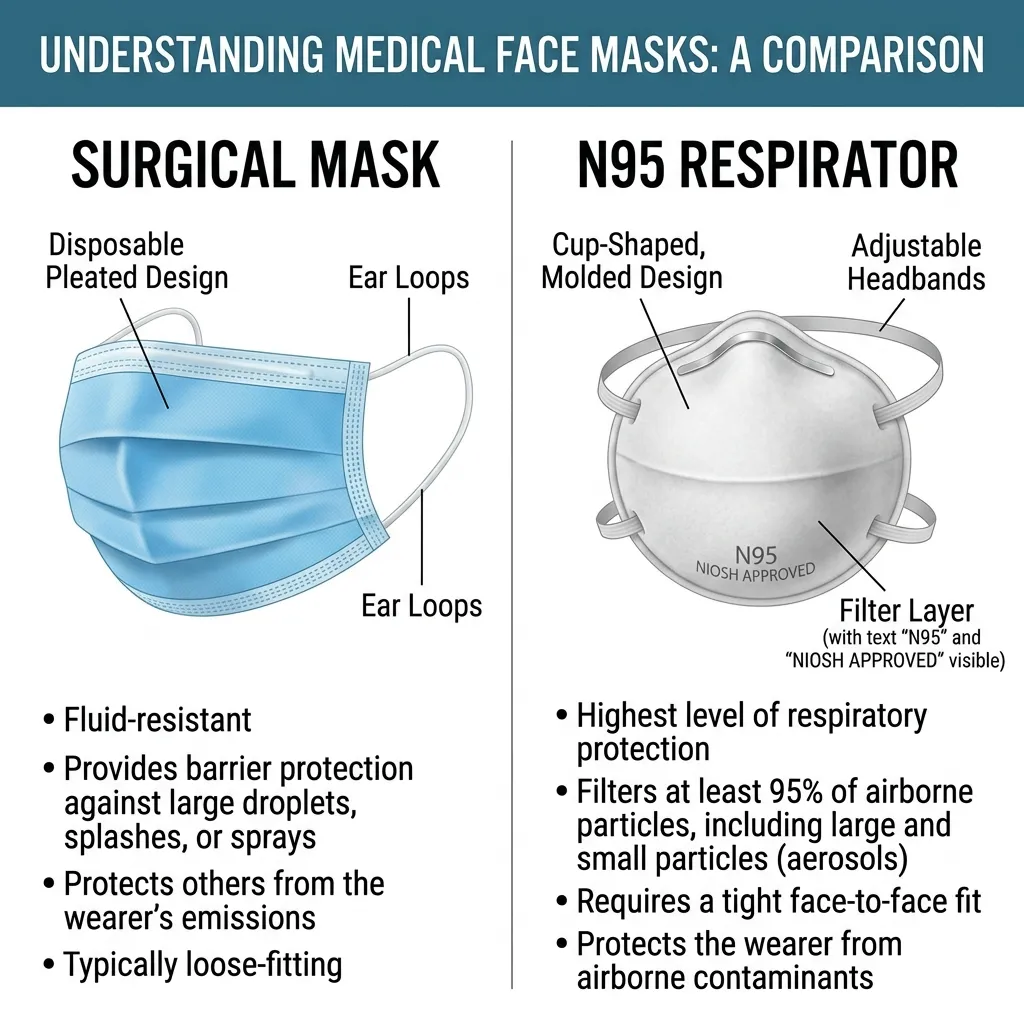
Surgical masks—also called medical masks or procedure masks—are the familiar blue-and-white masks you see in hospitals and clinics. They’re flat, pleated, and loosely fitted to the face, with ear loops or ties to hold them in place.
Their primary job is source control: they stop respiratory droplets from the wearer from reaching patients or surfaces. This is why surgeons wear them during operations—not to protect themselves from airborne pathogens, but to keep their breath away from open wounds.
Surgical masks typically filter around 95% of large droplet particles. However, their loose fit means they don’t seal tightly against the face, leaving gaps at the sides through which smaller airborne particles can pass. They’re not designed to protect the wearer from fine aerosols or high-concentration viral exposure.
Best for: Clinical settings, post-surgery recovery, mild illness, public transport, and environments where source control is the priority.
How Does an N95 Mask Differ From a Surgical Mask?
The N95 respirator is a significant step up. Regulated by the National Institute for Occupational Safety and Health (NIOSH), N95 masks filter at least 95% of airborne particles—including fine aerosols that surgical masks can miss.
The key difference is fit. N95 respirators form a tight seal around the nose and mouth, which is what makes them effective against airborne transmission. The “N” stands for “Not resistant to oil,” and “95” refers to the minimum filtration efficiency.
There are two main N95 designs:
- Cup-shaped – Rigid, dome-like structure that holds its shape
- Foldable (flat-fold) – More compact and easier to store, but equally effective when worn correctly
For an N95 to work properly, it must be fit-tested—a formal process used in occupational health settings to confirm the mask seals correctly against an individual’s face shape.
Best for: Healthcare workers, first responders, high-risk environments, and anyone with significant exposure to airborne pathogens.
What About KN95 Masks?
KN95 masks are the Chinese-standard equivalent of N95s, designed to filter at least 95% of particles. They’re widely available and generally more affordable, making them a popular choice for the general public. However, KN95s are not NIOSH-certified, so quality can vary by manufacturer. Always buy from a reputable supplier and look for masks with verified test results.
Disposable Face Masks: What You Need to Know
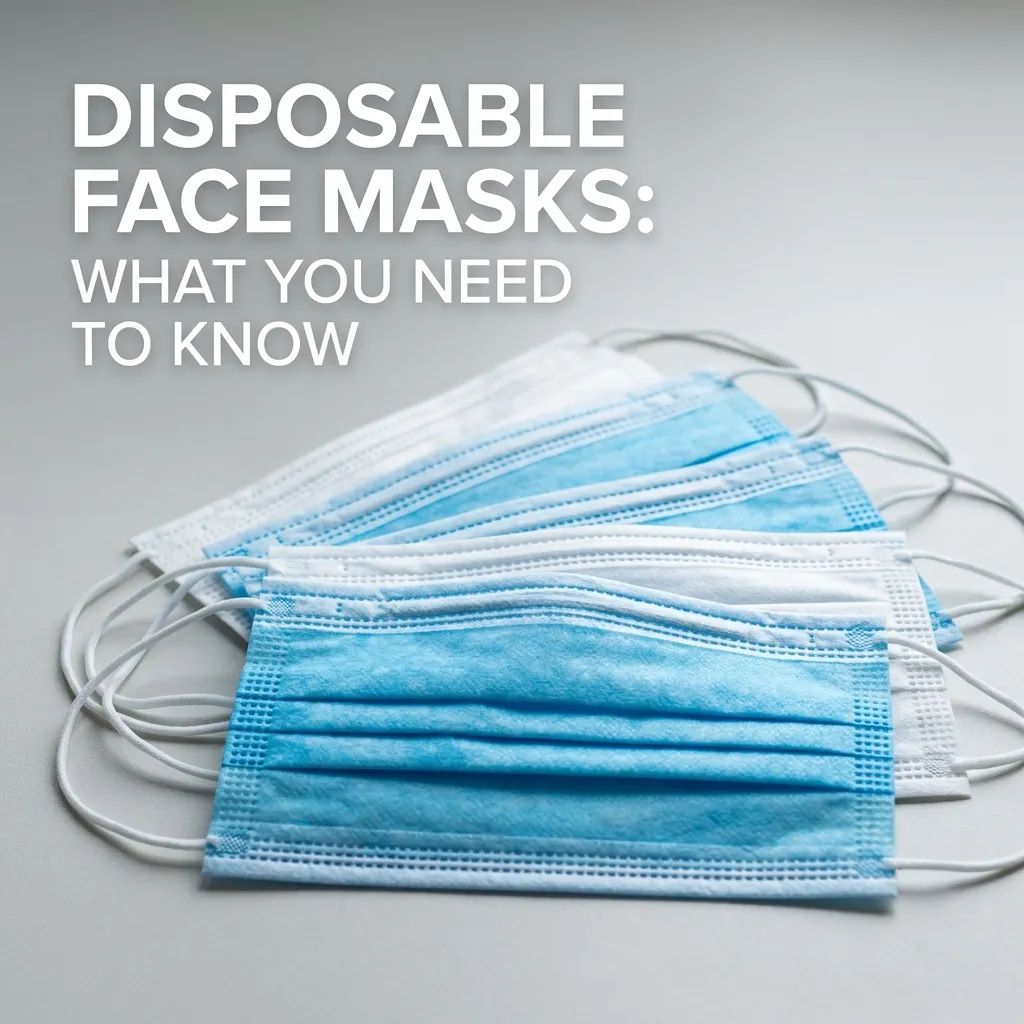
Disposable masks are designed for single-use only. Once worn, they should be discarded rather than cleaned or reused. This category covers both surgical masks and lower-grade non-woven polypropylene masks sold for general use.
Their main advantages are convenience and hygiene. You don’t need to worry about washing them or checking whether previous use has compromised the filtration material. Their main disadvantage is cost over time—and environmental impact, given that billions of disposable masks end up in landfills annually.
Key tips for disposable mask use:
- Never touch the front of the mask while wearing it
- Replace as soon as it becomes damp or soiled
- Store unused masks in a clean, dry place
- Do not reuse disposable masks, even if they look clean
Reusable Face Masks: Types and Benefits
Reusable masks are typically made from cloth or multi-layer fabric blends. They can be washed and worn multiple times, making them a more sustainable and cost-effective option for everyday use.
What Materials Are Best for Reusable Face Masks?
The filtration effectiveness of a reusable mask depends heavily on its material and layering:
- 100% tightly woven cotton – A solid baseline; blocks large droplets effectively
- Two-layer designs – A woven outer layer combined with a filter pocket dramatically improves filtration
- Three-layer masks – Outer woven fabric, filter layer (such as non-woven polypropylene), and a softer inner layer against the skin
A 2020 study published in ACS Nano found that a combination of cotton and natural silk or chiffon could filter more than 80% of fine particles, provided the mask fits snugly with no gaps. Fit is just as critical as material.
Best for: Daily public use, commuting, shopping, and low-to-moderate risk environments.
Protective Face Masks for Healthcare Workers
Healthcare workers require masks that meet strict performance standards. The two main options are surgical masks and N95 respirators—but the choice depends on the clinical situation.
For routine patient care with low aerosol risk (such as general ward rounds), surgical masks are typically sufficient. For aerosol-generating procedures (AGPs)—intubation, bronchoscopy, CPR—N95 or higher-rated respirators are the standard recommendation from the Centers for Disease Control and Prevention (CDC).
Some healthcare facilities also use:
- Powered Air-Purifying Respirators (PAPRs) – Battery-powered units that draw air through filters; used in high-risk settings
- Elastomeric respirators – Reusable rubber or silicone facepieces with replaceable filters
- Full-face respirators – Cover the entire face; used in extreme-risk or chemical exposure scenarios
Understanding Face Mask Protection Levels
Not all masks offer the same level of protection. The spectrum runs from basic cloth masks at the lower end to full-face respirators at the top.
|
Mask Type |
Filtration Efficiency |
Best Use |
|---|---|---|
|
Cloth mask (1 layer) |
~30–50% |
Low-risk public settings |
|
Cloth mask (3 layers) |
~70–80% |
Everyday public use |
|
Surgical mask |
~60–80% (droplets) |
Clinical source control |
|
KN95 |
≥95% |
General high-risk use |
|
N95 |
≥95% (NIOSH-certified) |
Healthcare, high-exposure settings |
|
PAPR |
≥99.97% |
Extreme-risk healthcare settings |
Filtration efficiency alone doesn’t tell the whole story. Fit, seal, and consistent usage matter just as much as the material itself. A poorly fitted N95 may offer less real-world protection than a well-fitting surgical mask.
How to Choose the Right Face Mask for Your Needs
The right mask comes down to three factors: your risk level, your environment, and your access.
Choose a surgical mask if:
You work in a clinical or medical setting with low-to-moderate aerosol risk, or you need effective source control in a public or professional environment.
Choose an N95 or KN95 if:
You’re in a high-risk environment, caring for someone who is seriously ill, or working in a healthcare setting where aerosol-generating procedures occur.
Choose a reusable cloth mask if:
You need an everyday mask for public settings, commuting, or general low-risk use, and you’re committed to washing it regularly between uses.
Choose a disposable non-medical mask if:
You need a short-term solution for a brief task or errand, and the environment doesn’t pose a significant aerosol risk.
A few additional tips:
- Always check for proper fit—no gaps around the nose, cheeks, or chin
- Replace masks showing signs of wear, damage, or reduced breathability
- Follow manufacturer guidelines for reusable masks regarding wash frequency and lifespan
- For children, look for masks specifically sized for pediatric use
The Bottom Line on Face Mask Types
Face masks are more nuanced than they might appear. A surgical mask and an N95 share a similar look but serve different purposes. A cloth mask can be highly effective or largely symbolic, depending on how it’s made and how it fits.
Matching your mask to your actual situation—rather than defaulting to whatever’s most convenient—is the most meaningful step you can take. For most people in low-to-moderate risk settings, a quality reusable mask or surgical mask offers solid protection. For those in high-risk environments, investing in NIOSH-certified N95 respirators and proper fit testing is worth the extra effort.
When in doubt, opt for a higher protection level. The cost of being over-prepared is low. The cost of being under-protected can be significant.
Frequently Asked Questions
What is the most protective type of face mask?
NIOSH-certified N95 respirators offer the highest filtration efficiency for everyday use, filtering at least 95% of airborne particles when properly fitted. In extreme healthcare settings, Powered Air-Purifying Respirators (PAPRs) offer even greater protection, filtering 99.97% or more of particles.
Can I reuse a disposable surgical mask?
No. Surgical masks are designed for single-use only. Reusing them can compromise their structural integrity, reduce filtration efficiency, and potentially transfer contaminants from the outer surface to your hands and face.
How is an N95 different from a KN95 mask?
N95 masks are certified by NIOSH under U.S. standards, while KN95 masks meet Chinese regulatory standards. Both claim to filter at least 95% of particles, but N95s undergo more rigorous independent testing. KN95s vary more widely in quality depending on the manufacturer.
How many layers should a cloth face mask have?
A minimum of two layers is recommended, with three layers providing meaningfully better filtration. The most effective reusable masks combine a woven cotton outer layer, a non-woven filter layer, and a soft cotton inner layer against the skin.
How often should I replace or wash my face mask?
Disposable masks should be discarded after each use. Reusable cloth masks should be washed after every one to two uses, or immediately if they become damp or soiled. Follow the manufacturer’s guidance on maximum number of washes before the mask should be retired.
Are there face masks specifically designed for children?
Yes. Pediatric-sized surgical masks and cloth masks are available and recommended for children. Adult masks should not be used on children, as the loose fit creates gaps that significantly reduce protection.
What are the main types of face masks?
The main types include surgical masks, N95 respirators, KN95 masks, disposable face masks, reusable cloth masks, and specialty respirators.
What is the difference between a surgical mask and an N95 mask?
Surgical masks mainly block respiratory droplets, while N95 respirators filter at least 95% of airborne particles and provide a tight facial seal.
Are KN95 masks as effective as N95 masks?
KN95 masks offer similar filtration performance but follow different certification standards. Quality depends on the manufacturer.
Can disposable face masks be reused?
No. Disposable masks are designed for single use and should be discarded after they become damp, damaged, or soiled.
Are reusable cloth masks effective?
Yes. Multi-layer cloth masks made from tightly woven fabric can provide good everyday protection when they fit properly and are washed regularly.
Which face mask is best for healthcare workers?
Healthcare professionals typically use surgical masks for routine care and N95 respirators for high-risk or aerosol-generating procedures.
How do I choose the right type of face mask?
Choose based on your exposure risk, environment, required protection level, and whether you need a disposable or reusable option.
How often should reusable face masks be washed?
Reusable cloth masks should be washed after every use or whenever they become dirty or damp.
What is the highest level of face mask protection?
NIOSH-certified N95 respirators provide high protection for most users, while PAPRs offer even greater protection in specialized healthcare settings.
Do children need different face masks than adults?
Yes. Children should wear properly sized pediatric masks to ensure a secure fit and effective protection.
