


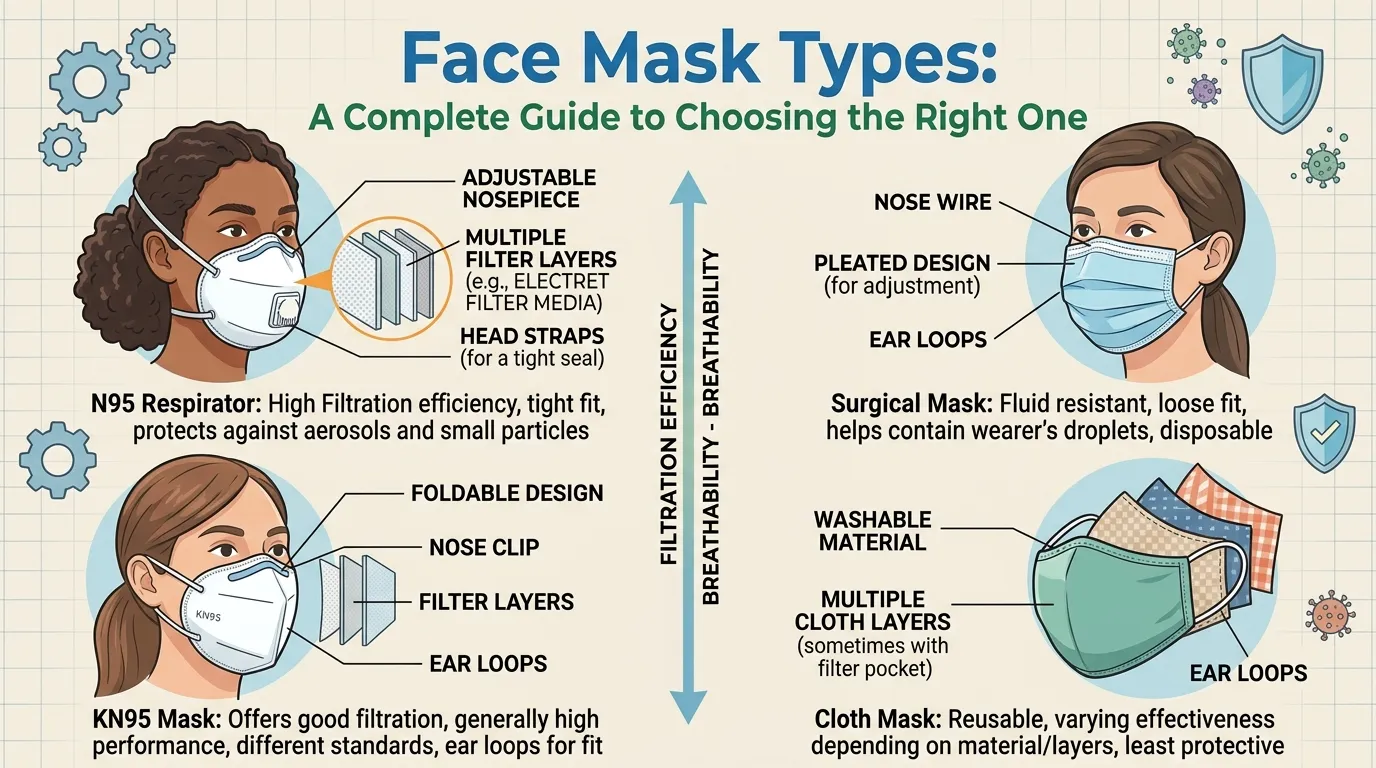
Face Mask Types include disposable medical masks, reusable cloth masks, and high-filtration respirators such as N95, KN95, and KF94 masks. Understanding different face mask types helps users choose the right level of protection, comfort, and breathability for everyday use, healthcare settings, travel, allergy protection, and airborne particle filtration.
Face Mask Types fall into three main categories: disposable medical masks (such as surgical and N95 masks), reusable cloth masks, and specialized respirators. Understanding different face mask types is essential for choosing the right level of protection, comfort, and breathability. N95 masks provide the highest protection by filtering at least 95% of airborne particles, while cloth masks offer basic coverage for everyday use.
Not all face mask types are created equal. Some are designed to block tiny airborne particles, while others primarily protect against larger respiratory droplets. Certain masks prioritize comfort and breathability, making them better suited for daily wear rather than high-risk environments.
If you’ve ever stood in a pharmacy aisle wondering which of the many face mask types to choose—whether a surgical mask, N95 respirator, or reusable cloth mask—you’re not alone. The wide range of options can be confusing, especially when each mask offers different levels of filtration, fit, and comfort.
This guide explores the most common face mask types, from disposable medical masks to reusable alternatives. You’ll learn how they compare in protection, when to use each option, and how to select the best face mask for your specific needs, whether you’re concerned about viruses, allergens, air pollution, or everyday protection.
What are the main types of face masks?
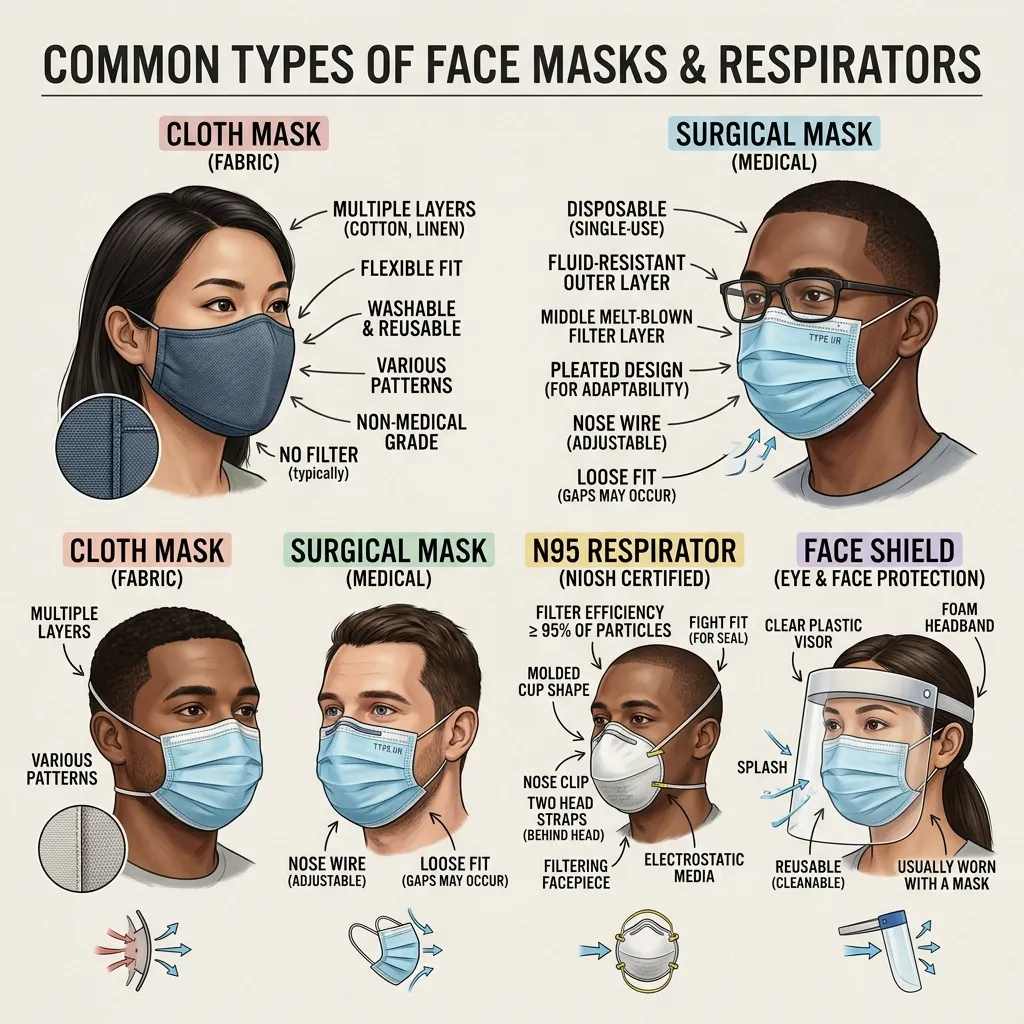
Face masks generally fall into three broad groups, each designed with a different purpose in mind:
- Medical masks: These include surgical masks and respirators like the N95. They’re regulated, tested for filtration, and built for healthcare and high-risk settings.
- Cloth masks: Reusable and washable, these are made from fabrics like cotton. They’re a budget-friendly option for everyday use.
- Specialty masks: This group covers everything from KN95s to industrial respirators and fashion masks with replaceable filters.
The right choice depends on what you’re protecting against. A surgeon needs different protection than a commuter on a crowded train, and a gardener with seasonal allergies has different needs than a construction worker breathing in dust.
Disposable face mask varieties
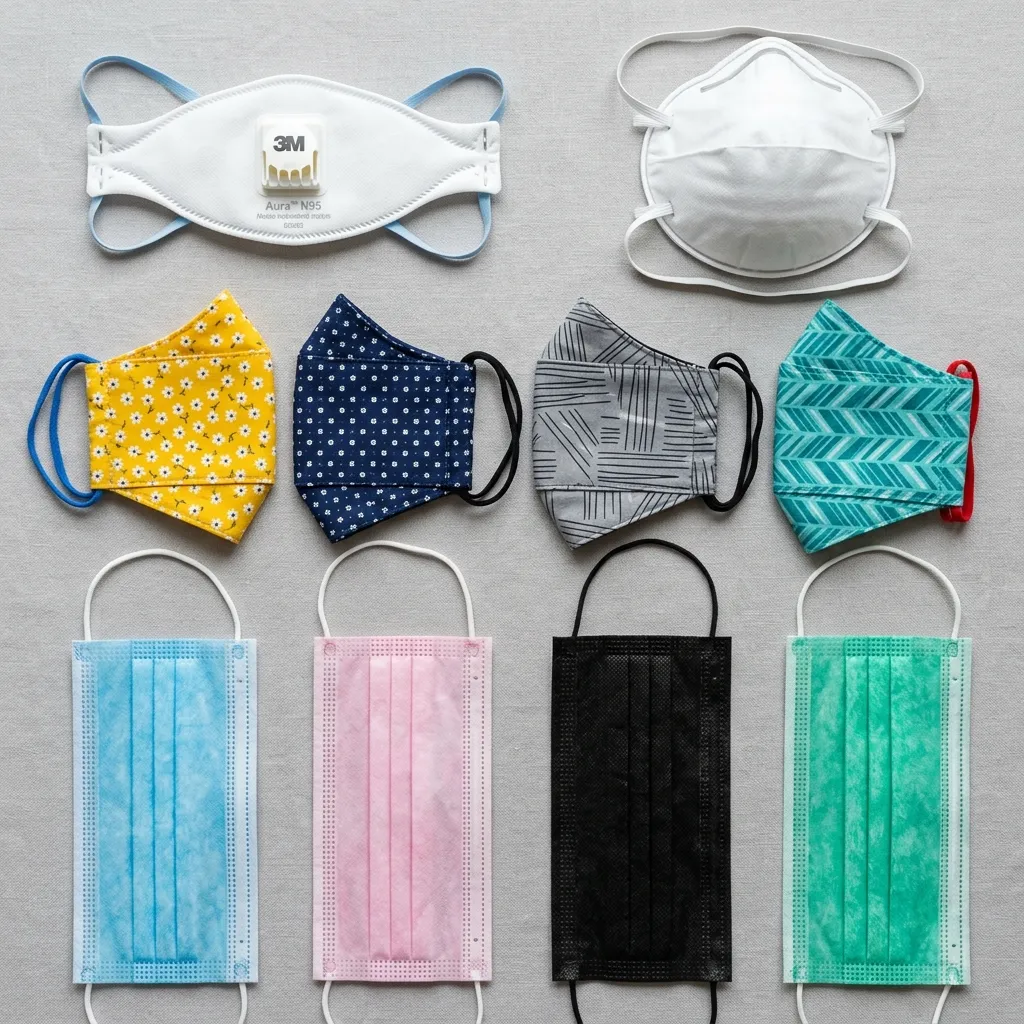
Disposable masks are designed for single use. You wear them once, then throw them away. They’re convenient, widely available, and often the first choice for short-term protection.
Surgical masks
Surgical masks are the loose-fitting, pleated masks you’ve probably seen most often. They’re typically made from three layers of non-woven material. The outer layer repels fluids, the middle layer filters particles, and the inner layer absorbs moisture from your breath.
These masks are great at blocking large respiratory droplets. They protect others from your germs and offer you some protection in return. However, because they don’t seal tightly against your face, smaller airborne particles can slip through the gaps along the sides.
Best for: Everyday errands, medical settings where droplet protection is enough, and situations where comfort matters over a tight seal.
Procedure masks
Procedure masks look almost identical to surgical masks but often use ear loops instead of ties. They’re commonly used in clinics and hospitals for routine care. The filtration is similar to surgical masks, making them a reliable choice for general protection.
Dust masks
The basic paper or foam dust masks sold at hardware stores are designed to keep out large particles like sawdust and pollen. They’re not medical-grade and won’t filter out viruses or fine pollutants. Treat these as comfort masks for light, dusty tasks rather than serious protection.
Medical face mask types and filtration levels
Medical masks are tested and rated for how well they filter particles. Understanding these ratings helps you compare protection levels at a glance.
Surgical masks in the United States are graded by the American Society for Testing and Materials (ASTM) into three levels:
- Level 1: Low barrier protection for general use and short procedures.
- Level 2: Moderate barrier protection for light to moderate fluid exposure.
- Level 3: Maximum barrier protection for heavy fluid exposure.
The higher the level, the more resistant the mask is to fluids and the better it filters bacteria. If you want stronger everyday protection from a disposable mask, look for Level 2 or Level 3 surgical masks.
N95 mask vs surgical mask: what’s the difference?
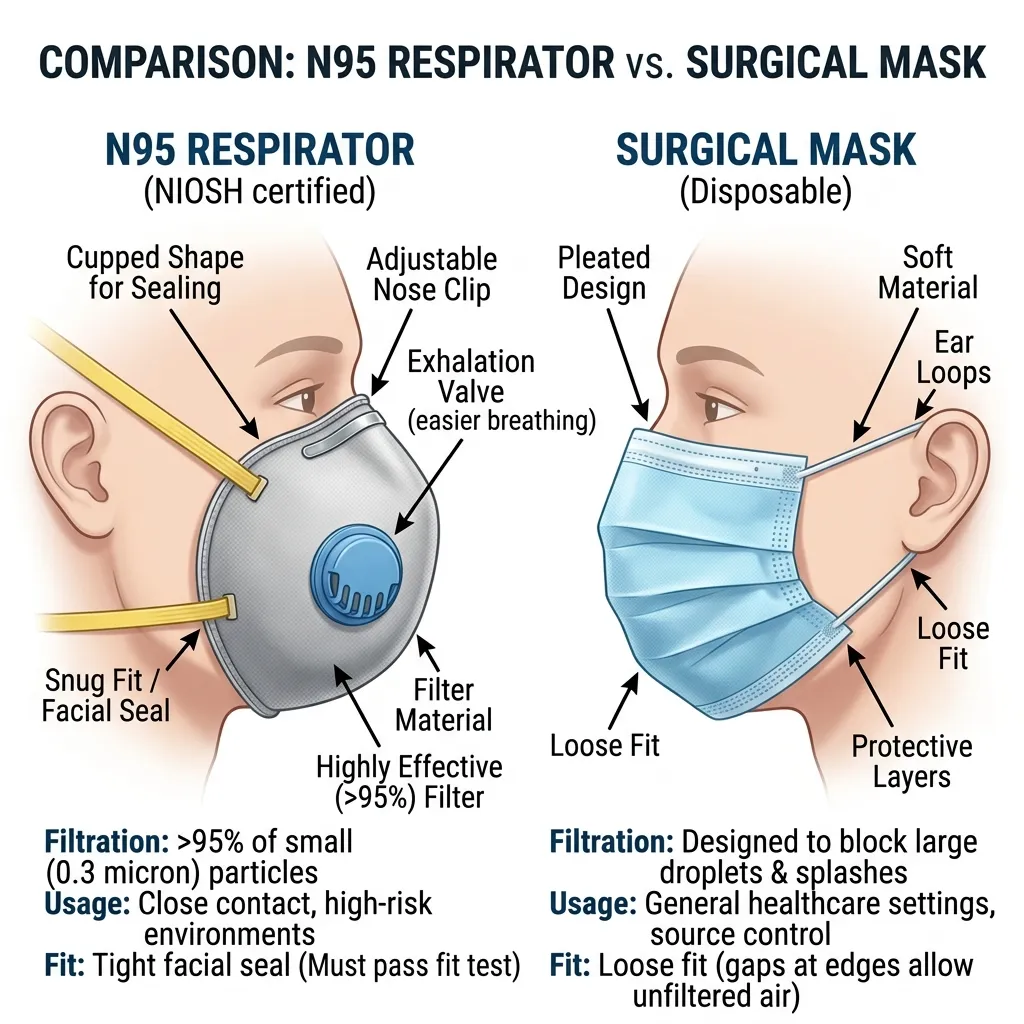
This is one of the most common questions, and the answer comes down to fit and filtration.
An N95 respirator filters at least 95% of airborne particles, including very small ones measuring 0.3 microns. It’s certified by the National Institute for Occupational Safety and Health (NIOSH). The key feature is its tight seal—when worn correctly, an N95 forms a snug fit around your nose and mouth, leaving little room for unfiltered air to sneak in.
A surgical mask, by contrast, is loose-fitting. It catches large droplets well but doesn’t seal against your face, so fine particles can enter through the gaps. Surgical masks also aren’t designed to filter the smallest airborne particles the way an N95 can.
Here’s a simple way to decide:
- Choose an N95 if you need maximum protection—during disease outbreaks, in healthcare settings, or when air quality is poor from wildfire smoke.
- Choose a surgical mask if you mainly want to block droplets, prioritize comfort and breathability, or need a mask for short, low-risk outings.
One trade-off worth noting: N95 masks are harder to breathe through because of their tight seal and dense filter. For long wear, some people find them uncomfortable.
Protective face mask categories beyond the N95
The N95 isn’t the only high-filtration option. Several similar respirators are common around the world, each meeting different regional standards.
KN95 masks
KN95 masks meet Chinese standards and also filter around 95% of airborne particles. They often use ear loops rather than head straps, which some people find more comfortable. The filtration is comparable to an N95, but fit can vary, so check that the mask sits snugly.
KF94 masks
KF94 masks follow South Korean standards and filter at least 94% of particles. Their boat-shaped design creates a roomy pocket in front of your mouth, which many wearers find more breathable while still offering strong protection.
FFP2 and FFP3 masks
These respirators meet European standards. An FFP2 mask filters at least 94% of particles, similar to a KN95, while an FFP3 mask filters at least 99%—making it one of the highest-protection options available.
Reusable face mask options
If you’d rather not toss a mask after every use, reusable masks offer a sustainable and cost-effective alternative. With proper washing, a good reusable mask can last for months.
Cloth face mask types
Cloth masks come in many forms, and their protection depends heavily on the fabric and construction:
- Single-layer masks: The thinnest option, offering minimal filtration. Better than nothing, but not ideal for high-risk settings.
- Multi-layer masks: Two or three layers of tightly woven fabric significantly improve filtration. The Centers for Disease Control and Prevention (CDC) recommends masks with multiple layers for better protection.
- Filter-pocket masks: These cloth masks include a slot where you can insert a disposable filter, boosting their effectiveness without sacrificing reusability.
The best cloth masks use tightly woven cotton, fit snugly without gaping, and stay breathable enough for comfortable all-day wear.
Masks with replaceable filters
Some reusable masks are built around a silicone or fabric shell that holds swappable filter cartridges. These can offer higher filtration than basic cloth masks while letting you reuse the outer shell. They’re a popular middle ground for people who want better protection without the waste of disposables.
Breathable face masks for daily use
Comfort matters more than you might think. A mask you can breathe in easily is a mask you’ll actually keep on. The most breathable everyday options include:
- KF94 masks, thanks to their roomy, boat-shaped design that keeps fabric off your lips.
- Lightweight cotton masks, which let air flow while still catching larger particles.
- Masks with adjustable nose wires and ear loops, which improve fit and reduce the constant adjusting that makes masks annoying.
For long days at work or while exercising, breathability often becomes the deciding factor. Just remember that the most breathable masks usually offer less filtration—so balance comfort against the level of protection you need.
What’s the best face mask for protection?
For maximum protection, N95 and equivalent respirators (KN95, KF94, FFP2, and FFP3) are the clear winners. They filter at least 94–99% of airborne particles and, when fitted correctly, seal tightly against your face.
But the “best” mask really depends on your situation:
- For the highest filtration: An N95 or FFP3 respirator.
- For everyday comfort and droplet protection: A Level 2 or Level 3 surgical mask, or a KF94.
- For sustainability and casual use: A multi-layer cloth mask, ideally with a filter pocket.
- For light, dusty tasks: A simple dust mask.
Whatever you choose, fit is just as important as filtration. Even an N95 won’t protect you well if air leaks around the edges. Look for a snug seal, a moldable nose wire, and adjustable straps.
Choosing the right mask for your needs
The best face mask is the one that matches your risk level, fits well, and is comfortable enough to wear consistently. For high-risk environments—crowded indoor spaces, healthcare settings, or smoky air—reach for an N95 or its equivalents. For everyday outings where comfort is a priority, a quality surgical mask or multi-layer cloth mask will serve you well.
Before you buy, think about three things: how much protection you need, how long you’ll be wearing the mask, and whether you prefer the convenience of disposables or the sustainability of reusables. Get those three factors right, and you’ll find a mask that protects you without becoming a nuisance.
Frequently asked questions
Are N95 masks better than cloth masks?
Yes, for filtration. N95 masks filter at least 95% of airborne particles and seal tightly to your face, while cloth masks offer far less protection and don’t seal as well. However, cloth masks are reusable, more comfortable for some people, and suitable for low-risk everyday situations.
How many times can you reuse a cloth face mask?
A well-made cloth mask can be reused for months if you wash it regularly. Wash it after each day of use with soap and hot water, and replace it once the fabric wears thin, stretches out, or no longer fits snugly.
What’s the difference between N95 and KN95 masks?
Both filter around 95% of airborne particles. The main difference is the certification standard: N95 masks meet U.S. NIOSH standards, while KN95 masks meet Chinese standards. N95s typically use head straps for a tighter seal, while KN95s often use ear loops for comfort.
Can disposable masks be reused?
Disposable masks like surgical and N95 masks are designed for single use and lose effectiveness once damp, soiled, or damaged. In a shortage, N95s can sometimes be rotated and reused for limited periods, but for best protection, replace disposable masks regularly.
Which face mask is most breathable?
KF94 masks and lightweight cotton masks tend to be the most breathable. KF94s have a boat-shaped design that keeps fabric off your mouth, while thin cotton masks allow easy airflow. Keep in mind that more breathable masks often provide less filtration.
What are the main face mask types?
The main face mask types are surgical masks, N95 respirators, KN95 masks, KF94 masks, cloth masks, and specialty respirators designed for specific environments.
Which face mask type offers the highest protection?
N95 respirators provide some of the highest levels of protection by filtering at least 95% of airborne particles when properly fitted.
What is the difference between N95 and KN95 masks?
N95 masks meet U.S. standards, while KN95 masks meet Chinese standards. Both provide similar filtration efficiency but may differ in fit and certification requirements.
Are cloth face masks still effective?
Multi-layer cloth masks can provide basic protection and help reduce the spread of respiratory droplets, especially when fitted properly.
Which face mask type is best for everyday use?
Surgical masks, KF94 masks, and quality multi-layer cloth masks are popular choices for daily wear due to their balance of comfort and protection.
Can disposable face masks be reused?
Disposable masks are designed for single use and should be replaced when damaged, dirty, or difficult to breathe through.
What face mask type is best for air pollution?
N95, KN95, and FFP2 respirators are among the best face mask types for filtering fine dust, smoke, and air pollutants.
How do I choose the right face mask?
Consider filtration level, fit, comfort, breathability, and the environment where the mask will be used.
Are masks with filters better than regular cloth masks?
Masks with replaceable filters generally provide better particle filtration than standard cloth masks while remaining reusable.
Why is understanding face mask types important?
Knowing the differences between face mask types helps you select the most suitable mask for protection, comfort, and specific health or environmental needs.
