


A surgical medical mask is a disposable 3-ply protective face covering designed to block respiratory droplets, bacteria, and fluids. Commonly used in healthcare settings, it helps reduce the spread of infections but does not provide the same level of protection as an N95 respirator. Proper use, fit, and disposal are essential for maximum effectiveness.
A surgical medical masks is a disposable, loose-fitting face covering that creates a physical barrier between the wearer’s mouth and nose and contaminants in the environment. Most are made from three layers of non-woven fabric, which is why they’re often called 3 ply surgical masks. They help reduce the spread of respiratory droplets, making them essential for infection control in healthcare settings.
Few medical products are as widely recognized—or as frequently misunderstood—as the surgical medical masks. You’ve seen them in hospitals, clinics, dental offices, and, more recently, on faces everywhere. But what actually goes into one? How does it protect you? And when does a basic surgical mask fall short?
This guide breaks down everything you need to know about the disposable surgical mask: how it’s built, what it protects against, how it differs from a respirator, and how to wear one correctly. Whether you work in healthcare or simply want to make smarter choices about respiratory protection, you’ll walk away with a clear understanding of what these masks can and can’t do.
Let’s start with the basics.
What is a surgical medical masks?

A surgical medical masks is a disposable face covering designed to protect both the wearer and those around them. It works in two directions: it stops large respiratory droplets, splashes, and sprays from reaching the wearer’s mouth and nose, while also trapping droplets the wearer exhales.
This dual function is why the hospital face mask became a cornerstone of infection control. Surgeons originally wore them to keep their own germs from contaminating open wounds and sterile environments. Over time, the protective medical mask earned a broader role across nearly every area of patient care.
Unlike cloth coverings, a medical-grade face covering must meet specific performance standards. Regulatory bodies like the U.S. Food and Drug Administration (FDA) classify these masks as medical devices, which means they’re tested for fluid resistance, filtration efficiency, and breathability before they reach the market.
How is a 3 ply surgical mask made?
The term “3 ply surgical mask” refers to the three distinct layers that give the mask its protective qualities. Each layer serves a different purpose, and together they form an effective non woven surgical mask.
What does each layer of a non woven surgical mask do?
- Outer layer: A colored, fluid-resistant non-woven fabric that repels splashes, droplets, and other liquids. This is the first line of defense.
- Middle layer: A melt-blown filter that captures bacteria and fine particles. This is the heart of the mask’s filtration ability.
- Inner layer: A soft, absorbent non-woven material that sits against the face. It absorbs moisture from the wearer’s breath and improves comfort.
Non-woven fabric is key to how these masks perform. Instead of being woven like traditional cloth, the fibers are bonded together through heat, chemicals, or pressure. This creates a dense, tangled web of fibers that traps particles far more effectively than woven materials of similar thickness.
What does a surgical mask protect against?
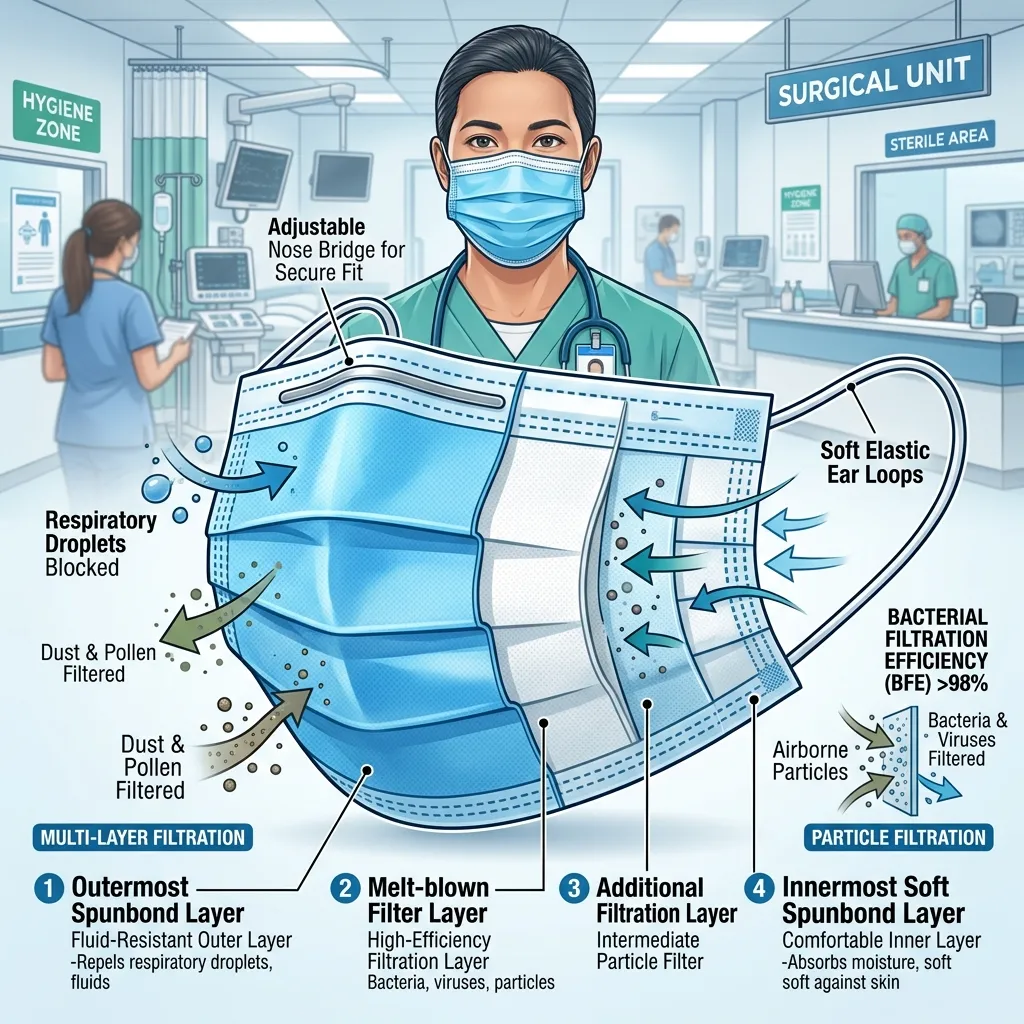
A surgical mask for infection control offers solid protection against several threats, but it’s important to understand its limits.
A disposable surgical mask is effective against:
- Large respiratory droplets released through coughing, sneezing, or talking
- Splashes and sprays of bodily fluids, which is critical during procedures
- The wearer’s own exhaled droplets, reducing the risk of spreading illness to others
However, a surgical mask is not designed to seal tightly against the face. Because air can leak around the edges, it doesn’t reliably filter very small airborne particles. For protection against fine aerosols—such as those carrying tuberculosis or certain viruses—a respiratory protection mask like an N95 respirator is required.
This distinction matters. Surgical masks reduce the spread of larger droplets, while respirators filter both large and small particles when properly fitted.
Surgical mask vs. respirator: which one do you need?
People often use “mask” and “respirator” interchangeably, but they’re built for different jobs. Choosing the right one depends on your situation.
Choose a surgical mask if your main goal is to block large droplets and splashes, prevent the wearer from spreading germs, and maintain general hygiene in clinical or public settings. The face mask for healthcare use is comfortable, breathable, and ideal for routine patient care, dental work, and everyday protection.
Choose a respirator (such as an N95) if you need to filter very small airborne particles and require a tight facial seal. Respirators are the standard choice when caring for patients with airborne diseases or working in environments with high concentrations of fine particles.
In short: a surgical mask protects against droplets and is more comfortable for long-term wear, while a respirator offers higher filtration but requires proper fit testing to work as intended.
When should you use a hospital face mask?
The protective medical mask plays a role far beyond the operating room. Common uses include:
- During surgery and sterile procedures, to keep the surgical site free from contamination
- Routine patient care, to limit the exchange of germs between staff and patients
- Dental procedures, where splashes and aerosols are common
- Caring for sick or immunocompromised patients, to add a protective barrier
- Public health situations, such as flu season or disease outbreaks, to slow the spread of respiratory illness
A medical-grade face covering is also widely used outside hospitals—in laboratories, pharmacies, and care facilities where hygiene is a priority.
How do you wear and dispose of a surgical mask correctly?
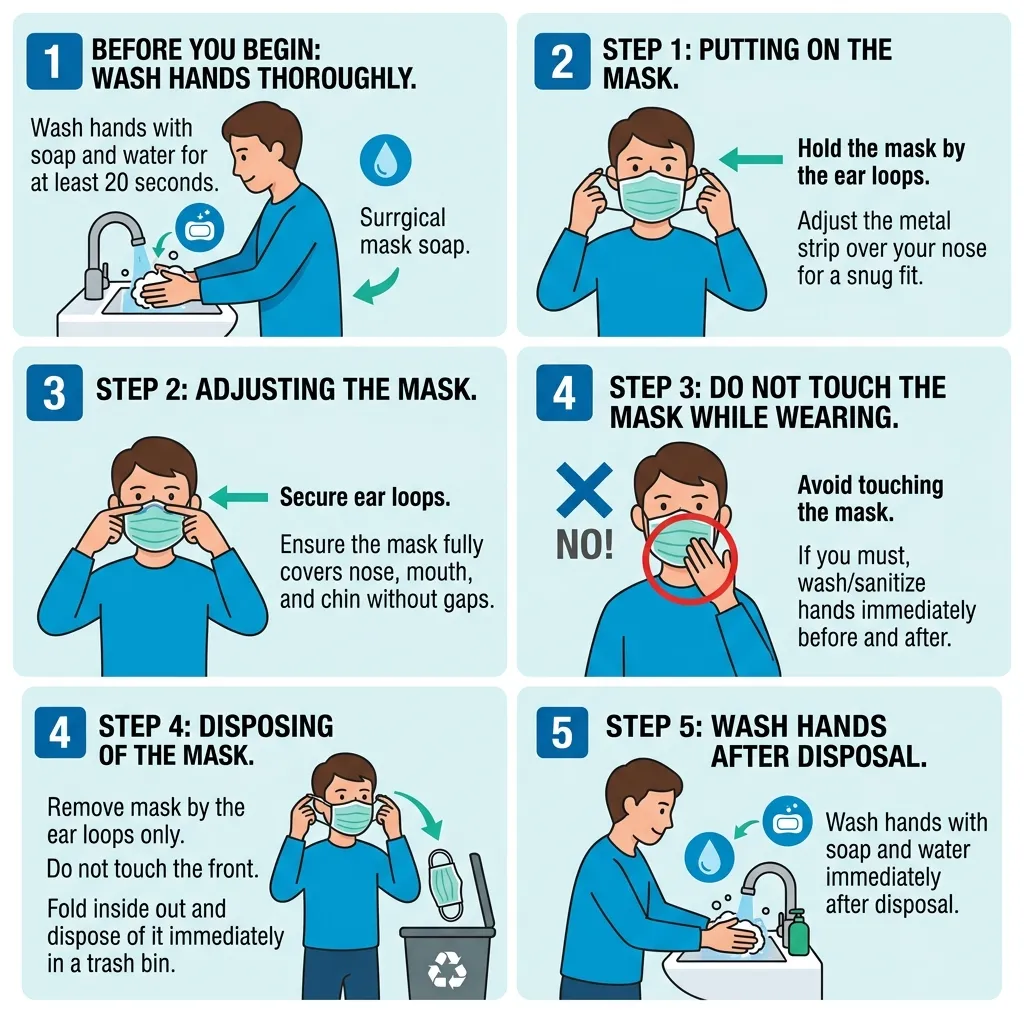
A protective medical mask only works if you use it properly. Even the best 3 ply surgical mask loses much of its value when worn incorrectly.
Step-by-step: putting on a disposable surgical mask
- Wash your hands thoroughly with soap and water or use hand sanitizer before touching the mask.
- Check the mask for tears, holes, or other defects.
- Identify the top edge, which usually contains a bendable metal strip, and make sure the colored side faces out.
- Secure the mask by looping the elastic bands over your ears or tying the straps behind your head.
- Mold the metal strip over the bridge of your nose for a snug fit.
- Pull the bottom down so it fully covers your mouth and chin.
Step-by-step: removing and disposing of the mask
- Avoid touching the front of the mask, which may be contaminated.
- Remove it by the ear loops or ties, not the body of the mask.
- Discard it immediately in a closed bin.
- Wash your hands again right after disposal.
Remember: a disposable surgical mask is single-use. Once it becomes damp, damaged, or soiled, replace it. Reusing a mask reduces its effectiveness and can increase contamination risk.
What should you look for when choosing a medical face mask?
Not all masks are created equal. When selecting a face mask for healthcare use, consider these factors:
- Filtration efficiency: Look for masks rated for bacterial filtration efficiency (BFE). Medical-grade options typically filter 95% or more of bacteria.
- Fluid resistance: Important for procedures involving splashes or sprays.
- Breathability: A good mask balances protection with comfort, so you can wear it for extended periods.
- Fit: While surgical masks don’t seal like respirators, a well-shaped nose strip and snug fit reduce gaps.
- Certification: Check that the mask meets recognized standards, such as ASTM levels in the U.S. or EN 14683 in Europe.
The ASTM rating system is especially helpful. Level 1 masks suit low-risk situations, Level 2 handles moderate exposure, and Level 3 offers the highest protection for procedures with heavy fluid contact.
Are surgical masks bad for the environment?
The convenience of a disposable surgical mask comes with an environmental cost. Because they’re made from non-woven plastic fibers like polypropylene, they don’t break down easily and contribute to plastic waste.
To reduce your impact, dispose of masks responsibly in proper waste bins, never litter them, and follow local guidelines for medical waste where applicable. Some manufacturers are now developing more sustainable alternatives, though these remain less common in clinical settings where performance standards are strict.
Making smarter choices about respiratory protection
The surgical medical masks is a simple device with a surprisingly important job. Built from three layers of non-woven fabric, it blocks droplets, resists fluids, and helps stop the spread of illness in hospitals, clinics, and beyond. Yet it works best when you understand its strengths and its limits—knowing when a basic mask is enough and when a respirator is the safer choice.
The next time you reach for a face mask for healthcare use, check the certification, confirm it fits well, and wear it correctly from start to finish. Those small habits make a real difference in protection.
If you’re stocking up for a clinic, a workplace, or your home, prioritize masks with clear ASTM or EN certifications and a filtration rating that matches your needs. The right mask, used the right way, is one of the simplest tools for keeping yourself and others safe.
Frequently asked questions
What is the difference between a surgical mask and an N95 respirator?
A surgical mask blocks large respiratory droplets and splashes but doesn’t seal tightly to the face, so it can’t reliably filter very small airborne particles. An N95 respirator forms a tight seal and filters at least 95% of both large and small particles, but it requires proper fit testing. Choose a surgical mask for routine droplet protection and an N95 for airborne disease protection.
Can you reuse a disposable surgical masks?
No. A disposable surgical mask is designed for single use. Once it becomes damp, soiled, or damaged, its filtering ability drops and contamination risk rises. Replace it with a fresh mask rather than reusing one.
What does “3 ply” mean on a surgical masks?
“3 ply” refers to the three layers of non-woven fabric in the mask: a fluid-resistant outer layer, a melt-blown filter middle layer that traps bacteria and particles, and a soft, absorbent inner layer that sits against the face. Together, these layers balance protection, filtration, and comfort.
How long can you wear a surgical mask before changing it?
There’s no fixed time limit, but you should replace a surgical mask whenever it becomes damp, dirty, or damaged—or after any single procedure where it may have been contaminated. In practice, many healthcare workers change masks between patients or several times during a shift.
What do ASTM mask levels mean?
ASTM levels rate a mask’s protection. Level 1 is for low-risk situations with minimal fluid exposure, Level 2 suits moderate exposure, and Level 3 provides the highest protection for procedures involving heavy fluid or aerosol contact. Higher levels
What is a surgical medical masks?
It is a disposable face mask used to block respiratory droplets, fluids, and bacteria to help prevent infection spread.
What is a 3-ply Surgical Medical Masks?
A 3-ply Surgical Medical Masks has three layers: an outer fluid-resistant layer, a middle filter layer, and an inner comfort layer designed for safe breathing and protection.
What does a Surgical Medical Masks protect against?
A Surgical Medical Masks protects against large droplets, splashes, and respiratory secretions but is not designed to filter fine airborne particles.
Is a Surgical Medical Masks reusable?
No, a Surgical Medical Masks is intended for single use only and should be safely discarded after use.
How long can you wear a Surgical Medical Masks?
A Surgical Medical Masks should be changed when it becomes wet, dirty, or after a few hours of continuous use for proper protection.
What is the difference between a Surgical Medical Masks and an N95 mask?
A Surgical Medical Masks blocks mainly droplets, while an N95 respirator provides a tighter seal and filters much smaller airborne particles.
How should a Surgical Medical Masks be worn?
A Surgical Medical Masks should fully cover the nose, mouth, and chin, with the metal strip pressed over the nose for a secure fit.
Can a Surgical Medical Masks prevent viruses?
A Surgical Medical Masks helps reduce the spread of viruses but does not completely block all airborne viral particles.
What materials are Surgical Medical Masks made of?
Surgical Medical Masks are usually made from multiple layers of non-woven polypropylene fabric for filtration and comfort.
When should a Surgical Medical Masks be changed?
A Surgical Medical Masks should be replaced if it becomes damp, damaged, or after exposure to potential contamination.
